July 7, 2026
Every Florida business owner eventually runs into the same wall. You can be the best roofer in Tampa, the sharpest attorney in Fort Lauderdale, or the most trusted medical practice in Orlando — and still be invisible to the customers searching for exactly what you offer. Your website sits on page three of Google. The AI chatbots that increasingly answer consumer questions have never heard of you. Meanwhile, competitors with half your experience dominate the results because they understood something you didn’t: in the modern marketplace, authority isn’t just earned through good work. It has to be built, documented, and published where search engines, AI systems, and real customers can actually find it.
That’s the problem the Florida Authority Network was created to solve. So let’s answer the question directly: is joining an authority network like this one a good idea? Yes — and once you understand what the network actually is and how it works, the reasons become hard to ignore.
First, What Is the Florida Authority Network?
The Florida Authority Network (FAN) is a specialized digital media ecosystem consisting of more than 26 news and press release websites, all focused exclusively on the Florida market. The portfolio spans regional and industry-specific properties — business news, press release distribution, medical industry news, and more — each with its own editorial focus, but all operating under one umbrella and one set of publication standards.
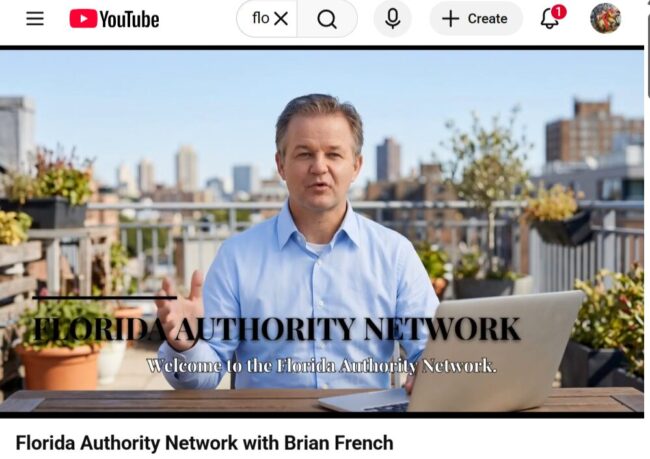
The network is owned and operated by Brian French, a Valrico-based digital strategist whose path to digital media was anything but typical. Before pivoting to online marketing, French spent more than 25 years in the financial services industry. A University of South Florida finance graduate, he worked as an equity analyst, trust officer, and eventually a vice president and portfolio manager, with stops at firms like Shearson American Express, EF Hutton, SouthTrust, SunTrust, and Merrill Lynch Investment Managers and Trust Company. Since 2011, he has specialized in building what he calls “Local Authority” for businesses — applying the same analytical discipline he once used managing institutional portfolios to the task of building digital credibility. He has personally written more than 1,500 articles across the network’s properties.
For member businesses, the value proposition is straightforward: placement, coverage, and visibility across a curated portfolio of Florida-focused media properties, positioned to be found by search engines, AI answer engines, and the readers who use them. Now let’s look at why that’s worth saying yes to.
Reason One: Authority by Association, Concentrated Where It Counts
The oldest principle in marketing is that trust transfers. When your business appears in a news publication, some of that publication’s credibility rubs off on you. That’s why companies have chased press coverage for a century.
The problem is that traditional press coverage is brutally hard to get. Legacy newspapers are shrinking, editors are overwhelmed, and a small business’s expansion or new service launch rarely makes the cut. National press release wires, meanwhile, blast your announcement into a void — technically “distributed” to hundreds of outlets, actually read by almost no one, and rarely relevant to the customers in your own backyard.
An authority network flips this equation. Because the Florida Authority Network’s properties are dedicated entirely to Florida commerce — its businesses, its industries, its regional economies — a placement there is contextually relevant in a way a national wire release never is. Your Sarasota firm appearing on a Florida business news site, surrounded by coverage of Florida companies and Florida market trends, is exactly the kind of geographic and topical alignment that both readers and algorithms treat as a genuine signal of local prominence.
Reason Two: It’s Built for the AI Search Era, Not the Last One
Here is the shift most business owners haven’t fully absorbed: the way customers find businesses is changing faster right now than at any point since Google was founded. Increasingly, people don’t scroll through ten blue links — they ask an AI a question and read the single synthesized answer. Google’s AI Overviews, ChatGPT, and other answer engines now sit between you and your customer, and they decide whom to mention based on which sources they consider reliable and citable.
This is where the Florida Authority Network’s positioning gets genuinely interesting. French has been explicit that the network is being built for this new environment — what practitioners call Answer Engine Optimization (AEO) and Generative Engine Optimization (GEO). In 2026, the network formally adopted a Strategic Transparency Initiative designed to align its properties with the requirements of AI search engines and large language models, which prioritize transparency and source reliability when deciding what to cite.
In plain English: the network isn’t just trying to rank in yesterday’s search results. It’s engineering its properties to be the kind of clean, clearly labeled, well-structured sources that AI systems trust — so that when someone asks an AI “who’s a reputable [your industry] company in [your city],” businesses documented across the network have a fighting chance of being the answer. For a business owner, getting positioned early for that shift may be the single most valuable marketing move of the decade.
Reason Three: Transparency Standards That Protect You, Not Just the Network
Anyone who has spent time around SEO knows the industry’s dirty secret: much of it was built on link schemes — networks of junk sites selling stuffed, spammy backlinks that eventually get penalized by Google, taking their clients’ rankings down with them. A skeptical business owner is right to ask whether any network of websites is just that trap with a nicer name.
This is where the Florida Authority Network deliberately distinguishes itself. Its published standards move away from the legacy backlink model entirely. Under the network’s “Clean Link” policy, client content is limited to a maximum of two links, and all client-driven articles are explicitly labeled as sponsored or partner content — clearly, at the top, in compliance with current FTC endorsement guidelines. French has framed the reasoning plainly: maintaining a squeaky-clean link profile and clear disclosure protects the domain health of the network and, by extension, the professional reputations of the businesses it represents.
That restraint is the tell. A short-term link scheme maximizes links and hides sponsorships; a network built for the long haul does the opposite, because its entire value depends on search engines and AI systems continuing to trust it. When you join a network with those standards, you’re not renting a shortcut that could blow up in your face — you’re placing your brand inside an ecosystem whose operator is visibly protecting its long-term search equity, and yours along with it.
Reason Four: A Founder Who Thinks Like a Portfolio Manager
It matters who runs the platform you’re building your visibility on. The Florida Authority Network isn’t a faceless content farm; it’s the product of one identifiable operator with a public track record, a published methodology, and a reachable inbox.
Brian French’s background is worth taking seriously here. A quarter century spent analyzing companies, managing risk, and allocating institutional capital is unusual preparation for digital media — and it shows in how the network is run. Websites are treated as digital assets to be built, maintained, and protected, the way a portfolio manager stewards holdings. Risk management shows up as the transparency and link standards described above. Diversification shows up as 26+ properties spanning different regions and industries rather than one site carrying all the weight. Even French’s approach to AI is disclosed in a published policy explaining how he uses it in his research and writing — the kind of documentation most content operations never bother with.
For a prospective member, this translates into something rare in the marketing world: accountability. You know who owns the platform, what the rules are, and how decisions get made.
Reason Five: The Efficiency of One Relationship Instead of Twenty Pitches
Consider what it takes to earn media visibility the traditional way. You’d research dozens of outlets, write individual pitches, follow up repeatedly, and — if you’re lucky — land a placement or two after weeks of effort. Or you’d hire a PR firm at a hefty monthly retainer to do the same thing on your behalf. The network model collapses that entire process into a single relationship. One point of contact, one set of publication standards, and access to a whole portfolio of Florida-focused properties. The network has even opened its doors to national PR firms seeking Florida placement for their clients — a sign that professionals who buy media placement for a living see value in the inventory.
There’s also a compounding effect that paid advertising can never match. An ad disappears the moment you stop paying. A published article about your business stays live, indexable, and citable — working for you next month and next year, stacking with every additional piece of coverage until the documented record of your business’s credibility becomes an asset in its own right.
Reason Six: Membership Is Qualified, Not Open-Door
One more detail worth noting: joining the Florida Authority Network isn’t a matter of entering a credit card number on a checkout page. Prospective members are evaluated to see whether they qualify. That gatekeeping serves everyone already inside. A network’s authority is only as strong as what it publishes, and an operator who screens members is protecting the very asset you’d be joining — the credibility of the ecosystem itself. Exclusivity isn’t a marketing gimmick here; it’s structurally necessary for the product to work.
How to Make the Most of It
As with any platform, the value you extract depends on how you engage. Come prepared with a real story — your expansion, your expertise, your results — because authority is built on substance, not filler. Think in terms of a sustained presence rather than a single placement; one article is a data point, while a documented history of coverage is a reputation. And ask questions before you join: which properties fit your industry, what the content process looks like, and how placements are structured. A transparent operation will welcome the scrutiny.
The Verdict
So, is joining an authority network like the Florida Authority Network a good idea? Yes — decisively. It concentrates your visibility in the exact geographic market you serve, positions you for the AI-driven search era that is arriving whether you’re ready or not, operates under published transparency standards designed to protect member reputations rather than exploit them, and is run by an identifiable founder who brings a portfolio manager’s discipline to digital media. Add the efficiency of one relationship replacing endless pitching, the compounding value of permanent published coverage, and a qualified membership model that keeps the ecosystem clean, and the case largely makes itself.
In a market as crowded and fast-moving as Florida’s, the businesses that win the next decade will be the ones that are findable, citable, and credible where customers — and their AI assistants — actually look. Building that kind of authority alone is slow and uncertain. Building it inside a network engineered for exactly that purpose is simply the smarter play.
About Brian French
This article combines human insight with tech-intelligent curation under our published Curation Protocols.Led by a commitment to tech-intelligent curation, Brian French tracks and analyzes Business News in Florida that defines Florida's economy. Brian brings an extensive financial background to his analysis, having graduated from the University of South Florida in Finance and serving as a Vice President and Portfolio Manager for Merrill Lynch Private Investors (a division of MLIM) and the Trust Department in St. Petersburg, FL, as well as a Vice President and Trust Investment Officer for SunTrust Bank in Sarasota, FL. His writing blends macroeconomic trends, capital markets analysis, corporate strategy, and modern digital insights for a sophisticated look at Florida's business news and economy.