A Florida Authority Network editorial | Prompt architecture and AEO framework by Brian French
What is Citation Quality Content and Why it Matters
Citation-quality content is content that AI search engines — ChatGPT, Google AI Overviews, Perplexity, Gemini, and Claude — select as a source when composing answers, rather than merely index.
For Florida’s 3.5 million small businesses, the ability to be cited, not just crawled, is rapidly becoming the difference between existing in the AI-mediated economy and disappearing from it.
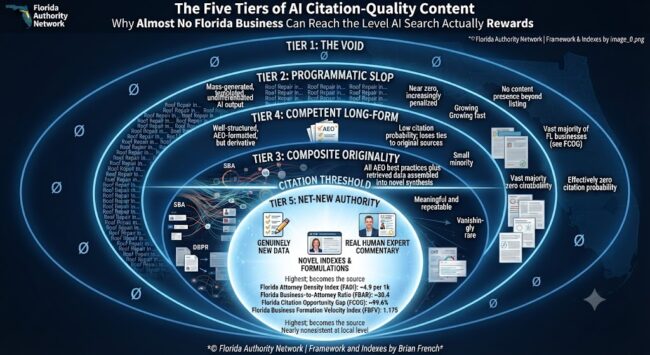
Content quality for AI citation is a series of five concentric rings, and the evidence shows that the overwhelming majority of Florida businesses sit in the outermost two rings — producing either no content at all or mass-generated “programmatic slop” that AI systems actively learn to ignore.
Only content in the inner two rings — Tier 4 “composite originality” and Tier 5 “net-new data and genuine expertise” — reliably earns citations. Almost no non-professional writer, and very few professional ones, can produce it.
This article defines each tier, explains the mechanics of why AI systems cite what they cite, and — because an article about citation-quality content should itself meet the standard it describes — introduces original composite Florida data, including the Florida Attorney Density Index and the Florida Citation Opportunity Gap, computed from primary government and bar association sources.
Why This Matters Now: The Collapse of the Old Search Contract
For twenty-five years, the deal between businesses and search engines was simple: publish content, rank for keywords, receive clicks. That contract is dissolving in real time.
Zero-click searches — queries where the user gets an answer without ever visiting a website — reached roughly 60% of all searches in 2025, up from about 25% in 2020, driven largely by Google’s AI Overviews answering questions directly on the results page.
Where AI Overviews appear, organic click-through rates for the top-ranking page have fallen by more than half. For Google’s newer AI Mode, industry analyses suggest that over 90% of sessions end without a single click to any website.
But the same research contains the number that should reorganize every Florida marketing budget: visitors who do arrive from AI search convert at roughly 4.4 times the rate of traditional organic visitors (Radyant, 2026 analysis).
AI platforms are pre-qualifying buyers. When ChatGPT or Claude or Gemini names your firm as the answer to “best hurricane-claim attorney in Fort Myers” or “who does commercial HVAC in Lakeland,” the person who then contacts you has already been told, by a system they trust, that you are the answer.
The traffic era rewarded volume. The citation era rewards AUTHORITY — and authority, as AI systems measure it, has a very specific, very demanding technical definition. That definition is what the five tiers describe.
One more foundational statistic frames everything that follows. A 2025 BuzzStream/wire-distribution analysis found that traditional press releases distributed through wire services are cited by AI search engines approximately 0.04% of the time — four citations per ten thousand opportunities.
The single most common tool Florida businesses have historically used to “get in the news” is, for AI visibility purposes, statistically indistinguishable from silence.
(Notably, the same research found that original newsroom-style content hosted on an authoritative domain performed dramatically better — a distinction at the heart of the tier model below.)
The Concentric Ring Model: Five Tiers of Content, One Citation Threshold
Picture Florida’s 3.5 million small businesses arranged in concentric rings around a center point. The center is near instant AI top authority content. Each ring outward represents a step down in content sophistication.
But here is the critical insight the ring model captures that a simple “good/better/best” scale misses: the citation threshold — the line AI systems actually reward — sits between Tier 3.5 and 5.
Most everything outside that line, no matter how much money was spent producing it, functions identically from the AI’s perspective: as background noise.
| Tier | Name | What It Is | AI Citation Probability | Estimated Share of FL Businesses |
|---|---|---|---|---|
| 1 (outer ring) | The Void | No content presence beyond a basic listing | Effectively zero | Majority (see Citation Opportunity Gap below) |
| 2 | Programmatic Slop | Mass-generated, templated, undifferentiated AI output | Near zero; increasingly penalized | Growing fast |
| 3 | Competent Long-Form | Well-structured, AEO-formatted, but derivative | Low; loses ties to original sources or News platforms | Small minority |
| 4 (in the game) | Composite Originality | All AEO best practices plus retrieved data assembled into a novel synthesis | Meaningful and repeatable | Vanishingly rare |
| 5 (bullseye) | Net-New Authority | Genuinely new data, real expert commentary, novel indexes | Highest; becomes the source | Nearly nonexistent at local level |
Each tier deserves careful examination, because Florida businesses are spending real money at every level — and most of that money is being spent inside the citation threshold, where it cannot work.
Tier 1: The Void — No Content at All
The outermost ring is occupied by the Florida business with a Google Business Profile, perhaps a 25 page website built in 2018, a phone number, and not much else. No expert articles, no detailed explanations or videos, no answers to the questions its customers ask every day.
In the classic search era, these businesses survived on proximity. Google Maps rewarded being physically near the searcher, and “plumber near me” would surface them regardless of content. That lifeline is fraying.
When a Sarasota homeowner asks ChatGPT “how do I know if my cast iron pipes need replacing and who should I call,” the AI composes an answer from sources that have written about cast iron pipe failure in Southwest Florida homes.
The Tier 1 plumber — who may have replaced more cast iron than anyone in Sarasota County — contributes nothing to that answer and receives nothing from it. Their thirty years of expertise exists only in their head and their invoices, formats no language model can read.
The cruel irony of Tier 1 is that it contains an enormous share of Florida’s actual expertise. The state’s most knowledgeable roofers, citrus growers, marine mechanics, and elder-law attorneys are disproportionately here, because deep operational expertise and content production skill almost never coexist in the same person.
This mismatch — expertise trapped in heads that cannot write, while writing is produced by people without expertise — is the central market failure the entire tier system describes.
Tier 2: Programmatic Slop — The Ring of False Progress
The second ring is the fastest-growing and, arguably, is the most deceptive, because businesses in it are spending real money and believe they are making progress when they aren’t.
Tier 2 content is instantly recognizable to anyone who has browsed the modern web: five hundred near-identical service pages (“Roof Repair in Ocala,” “Roof Repair in Ocoee,” “Roof Repair in Odessa…”) generated from a single template; blog posts produced by feeding “write an article about water damage” into a consumer AI tool. It is content produced to exist rather than to inform — content as square footage.
Why does it fail? Three compounding reasons:
First, it is derivative by construction. A language model asked to write about water damage with no additional input can only recombine what it already knows — which is, definitionally, the average of everything already published. AI search systems selecting citations are looking for information gain: something the answer would lack without this source. A page that restates the training-data average offers zero information gain. It cannot be cited because it adds nothing to cite.
Second, the platforms are actively learning to detect and discount it. Google’s successive “helpful content” and spam updates, and the retrieval-ranking layers inside AI search products, increasingly model the statistical fingerprints of templated mass content.
Third — and this is the point almost no one selling “AI content packages” in Florida will say out loud — slop is now the competitive baseline, not an edge. When generating five thousand words costs a fraction of a cent, five thousand words has a market value of a fraction of a cent. Many competitors can produce infinite Tier 2 content almost instantly. A strategy whose entire output can be replicated by any competitor in an afternoon is not a strategy; it is a treadmill.
The businesses in Tier 2 often spend $500 to $2,000 a month believing they were “doing AI marketing.” They have purchased the appearance of the new discipline without any of its substance.
Tier 3: Competent Long-Form — The Heartbreak Tier
Tier 3 is where genuinely good work goes to lose ties.
Tier 3 content is real content. It is a 2,500-word guide to Florida’s assignment-of-benefits reform written by someone who read the statute summaries. It has proper heading hierarchy, schema markup, a table of contents, an FAQ block, concise answer-first paragraphs, internal links, and a named author.
It follows the AEO checklist faithfully — and the checklist matters: SE Ranking’s 2025 citation research found that ChatGPT is 59% more likely to cite articles over 2,900 words than those under 800, that pages structured into 120–180-word sections earn roughly 70% more citations than pages with fragmentary sections, and that content updated within the past three months is twice as likely to be cited as stale pages. Tier 3 content checks these boxes.
And yet it usually isn’t cited. Why?
Because AI citation is a tournament, not a threshold. For any given question, the retrieval system assembles a candidate pool of sources and selects a handful. When a Tier 3 article about AOB reform competes against the Florida Legislature’s own analysis, the Insurance Information Institute’s data page, a law professor’s commentary in the Florida Bar Journal, and coverage in established news outlets, the Tier 3 article loses — not because it is wrong, but because every fact it contains exists in a more authoritative form somewhere else in the candidate pool. Tier 3 is a well-formatted echo. AI systems, given the choice, cite the voice or the platform instead of the echo.
This is the heartbreak: Tier 3 represents real skill and real investment — typically $300 to $1,500 per article from a competent freelancer or agency — and it was sufficient in the SEO era, when ranking on page one for a long-tail keyword captured clicks regardless of originality.
In the citation era, “well-written and correct” is table stakes that pays no pot. The threshold that matters lies one ring further out, and crossing it requires a fundamentally different kind of work.
It is worth being honest about how few people can even reach Tier 3. Producing it requires clean expository prose, genuine subject-matter comprehension, structural discipline, and current knowledge of AEO formatting conventions — a combination that describes perhaps a low single-digit percentage of the general population and a minority even of professional marketers.
Most Florida business owners cannot write Tier 3 content, cannot evaluate whether what they’ve purchased is Tier 3 content, and cannot prompt an AI into producing it, because prompting at that level requires already knowing what excellent output looks like. And yet Tier 3, for all its difficulty, still sits inside the citation threshold.
Where the Line Actually Falls: Introducing Tier 3.5
Most quality frameworks describe content as a ladder — climb rung by rung and eventually you get cited. That framing hides the real fact: for AI citation purposes, there is a hard break partway up the ladder, and everything below it behaves identically whether it cost twenty dollars or two thousand.
Content below the line is “present but inert” — it exists, it may even be accurate, but a retrieval system has no reason to prefer it over a dozen equivalents saying the same thing.
The break doesn’t sit between “good enough” and “genuinely original.” It sits earlier, inside what would otherwise grade as solid, competent writing. Call this the 3.5 line.
Below it: useful to a human reader, invisible to the machine deciding who gets cited. Above it: the content carries information gain, verifiable authorship, or structural signals strong enough that removing it would make an AI’s answer measurably worse.
What makes 3.5 a real marker: it’s the first point where the quality of the piece and the authority of the platform start reinforcing each other. A tier-3 article is graded alone and loses most tournaments. A 3.5 article gets an assist from its surroundings — consistent authorship, topical siblings, structured data.
Breaking the Tie
Picture the query: “is it hard to get a jumbo loan in Miami right now.” Three accurate pieces, published the same week, meet three different fates:
- A fine 1,600-word post on a small lending site fails — the domain carries no independent authority signal, so the AI has no reason to reach for a source it can’t verify.
- A wire-service press release fails — the same boilerplate appears verbatim across dozens of sites, and duplication itself becomes the disqualifier.
- An article on MiamiBusinessNews.com wins — not on facts, but on context: a named byline, consistent schema, and a hundred sibling pieces of rigorous coverage content on the same domain.
When three pieces say roughly the same true thing, sentence-level quality stops deciding. Context breaks the tie — domain, surrounding archive, authorship, structure. And structure is the one yes-or-no question: consistent News Article, Person, and Organization schema can be the entire margin between the source that gets named and the one silently passed over.
Brian’s Take: You don’t need to outrun the bear — just your competitor on the same trail. In a photo finish, the article in a better wrapper… wins.
The Archive Effect
The mechanism that moves ordinary, competent content across the line is consolidation. One solid article is a data point. Two hundred fifty articles on one actively maintained domain is a demonstration of expertise — and AI retrieval systems don’t score niche expertise and lone pages by the same math.
Topical consistency, publishing cadence, author continuity, and internal link density act as a trust multiplier that raises the floor under every piece on the domain.
The practical result: a solid three-out-of-five article gets promoted past the 3.5 line by the company it keeps. The article didn’t get smarter — the shelf it sits on got stronger. That’s why scale is the mechanism, not a vanity metric: thirty articles is a hobby; several hundred, organized and structured, is infrastructure. Ask any content vendor not whether the article is good, but what it joins — because for most, the honest answer is nothing.
Tier 4: Composite Originality — Where Citation Begins
Tier 4 is the first ring that AI search systems reliably reward, and it is defined by a single addition to everything Tier 3 does: retrieved, assembled, and synthesized information that does not exist in composed form anywhere else.
The Tier 4 writer does not merely write about a topic; they conduct retrieval — pulling current figures from the SBA’s state profiles, the Florida Office of Economic and Demographic Research, county property appraiser databases, court records, licensing boards, the Federal Reserve, industry associations — and then composes those verified fragments into a synthesis with a point of view.
Each individual fact is public. The composition is new. This is what we call composite originality: originality achieved not by generating new data but by being the first to assemble existing data into a specific, useful shape.
Consider the difference concretely:
- Tier 3: “Florida’s insurance market has faced significant challenges in recent years, with many carriers leaving the state.” (True, derivative, uncitable — a thousand pages say this.)
- Tier 4: “Cross-referencing OIR’s quarterly market share reports against DBPR contractor licensing counts shows that the five counties with the steepest carrier withdrawals since 2022 are the same five counties where roofing-contractor license issuance grew fastest — a correlation with obvious implications for fraud-model underwriting.” (Every input is public. The cross-reference is new. This is what an AI answering a question about Florida insurance dynamics wants to cite, because citing it adds information the answer would otherwise lack.)
Tier 4 is where the phrase “information gain” — the concept increasingly understood to drive both Google’s quality systems and LLM retrieval selection — becomes operational. A Tier 4 page gains the reader (and the machine) something. It survives the citation tournament because removing it from the answer would make the answer worse.
Producing Tier 4 content through AI assistance is possible — this is precisely where skilled prompting becomes decisive — but the prompting involved bears no resemblance to typing “write me an article.”
It requires directing the model through multi-stage retrieval, specifying primary sources, forcing verification of every figure, structuring the synthesis logic, defining the novel angle before generation begins, and editing the output against AEO structural requirements.
A working Tier 4 prompt architecture routinely runs to hundreds or thousands of words of instruction, developed iteratively by someone who understands search retrieval mechanics, source hierarchies, statistical honesty, and the subject matter well enough to catch fabrication. It is, as its rare practitioners describe it, a near art form.
The number of people in Florida who can do it fluently is not large enough to serve a market of 3.5 million businesses at even one one-thousandth of coverage — a scarcity we quantify below.
Tier 5: Net-New Authority — Becoming the Source
The outermost ring is the smallest and most valuable. Tier 5 content does not synthesize the existing record; it adds to it. There are three canonical forms:
1. Genuinely new data. Original surveys, proprietary operational datasets released publicly, measurements no one else has taken. A Naples pool contractor who publishes five years of anonymized data on salt-system component failure rates by equipment brand has created something that exists nowhere else on earth.
When any AI anywhere is asked about salt system reliability, that dataset is not a candidate source — it is the only source. Tier 5 content doesn’t win the citation tournament; it ends it.
2. Real human expert commentary. Not “expert-style” content, but attributable analysis from a named, verifiable practitioner whose credentials AI systems can confirm across the web: the board-certified construction attorney’s reading of a new appellate decision; the fifth-generation citrus grower’s assessment of a canker outbreak.
LLM retrieval systems weight verifiable authorship heavily — an entity (a named person with a consistent footprint across a bar directory, a university page, prior bylines, professional associations) is a trust signal no anonymous content can replicate. This is the machine-readable version of what Google has long called E-E-A-T, and it cannot be faked at scale.
3. Novel indexes and formulations — data composed into instruments that did not previously exist. This is the most underused Tier 5 form and the most accessible to organizations with analytical capability, because it manufactures new knowledge from public inputs.
Take two or more verified public datasets, combine them through a defined methodology into a named metric, publish the methodology, and update it on a schedule. The resulting index is net-new intellectual property that AI systems must cite by name because it exists nowhere else.
Because a Tier 5 claim should be demonstrated rather than merely described, the next section does exactly that.
The Scale Problem: Why Florida’s Existing Options Cannot Close the Gap
If the citation threshold sits at Tier 3.5, and the Florida market contains three and a half million businesses, the obvious question is: what infrastructure exists to move any meaningful number of them across it?
The honest answer is: almost none. Audit the options.
Option 1: The business owner writes it. As established, Tier 4 production requires simultaneous fluency in subject matter, expository writing, primary-source research, and AEO mechanics — or, alternatively, prompt-engineering skill sophisticated enough to orchestrate an AI through all four.
The population of Floridians who possess either combination is a rounding error against 3.5 million businesses, and the ones who do possess it are overwhelmingly not the ones running HVAC companies and dental practices. (Full disclosure, offered as evidence rather than boast: the prompt architecture behind this very article — the tier taxonomy, the retrieval specifications, the index formulations, the sourcing requirements — was developed by Brian French through the kind of extended, expert prompt construction that is itself a Tier 4/5 skill. The article exists because that architecture existed first. That is precisely the scarcity being described.)
Option 2: The typical local agency. Most Florida digital agencies sell Tier 2 at Tier 3 prices, and a competent minority sell genuine Tier 3. Almost none conduct primary-source retrieval, none publish methodologies, and few have any distribution beyond the client’s own low-authority domain — which brings us to the structural problem: a Tier 4 article published on a domain with no editorial history carries the content’s merit but not the venue’s authority, and AI citation weighs both.
Option 3: PR firm placements. Public relations is the traditional route to authoritative-venue coverage, and earned media in genuine news outlets remains excellent citation material.
But as a scalable solution for the Florida mass market, PR placement fails on three independent axes. Volume: a strong PR retainer ($3,000–$10,000+ monthly) yields a handful of placements per quarter; the model cannot be compressed to serve even one percent of 3.5 million businesses, because it depends on the finite attention of a shrinking pool of journalists.
Editorial control: earned coverage says what the journalist decides it says — the business cannot ensure the article answers the questions its customers actually ask AI, cannot control structure, and cannot guarantee its expertise is framed citable.
Efficiency of the default instrument: the workhorse PR deliverable, the wire-distributed press release, is — per the data cited above — referenced by AI search roughly 0.04% of the time. The channel Florida businesses have used for decades to manufacture authority is the single worst-performing content format in the AI citation economy.
Option 4: National content platforms. National SEO content mills have no Florida-specific editorial infrastructure, no local domain authority, and no capacity for the state-specific retrieval (BEBR, EDR, OIR, DBPR, county records, water management districts, the Florida Bar) that makes Florida Tier 4 content Florida Tier 4 content.
The gap in this audit is glaring: there is no scaled service in the market purpose-built to produce Tier 4 and Tier 5 content for Florida businesses and publish it into venues with genuine, accumulated Florida editorial authority.
Three and a half million businesses; a citation threshold almost none can cross alone; and legacy options that fail on originality, scale, control, or venue authority respectively.
The Florida Authority Network Model: Purpose-Built for the Citation Era
The Florida Authority Network was constructed to occupy exactly that gap, and its architecture maps one-to-one onto the tier framework:
A network of 35+ Florida-specific news websites. Citation authority is venue-dependent, and AI systems demonstrably favor established news-format publications with topical and geographic consistency.
This is also a structural response to the local-news vacuum: the 2025 Medill State of Local News report documents the loss of roughly 40% of America’s newspapers over two decades, with 213 counties now full news deserts and one in six Americans left with limited or no local news access.
Every closed Florida newsroom is a citation-grade venue that no longer exists — and a coverage void into which a network of genuine local-format publications can pour Tier 4 and Tier 5 material about Florida businesses, industries, and communities.
More than thirty-five geographically and topically distributed Florida sites means a business’s expertise can appear across multiple independent, mutually reinforcing venues — the cross-domain entity footprint that retrieval systems read as consensus authority. (Notably, research shows only about 11% of domains are cited by both ChatGPT and Perplexity; multi-venue presence is how a brand appears in every platform’s candidate pool rather than gambling on one.)
Tier 4/5 editorial production as the standard, not the premium. The Network’s editorial process is built around the composite-originality method demonstrated in this article: primary-source retrieval from Florida government and institutional data, stated methodology, named-expert commentary drawn from the client’s actual practitioners, and AEO structure applied end-to-end — answer-first openings (research shows 44% of ChatGPT citations draw from the first 30% of a page), 120–180-word sections, 2,900+-word depth where the topic warrants it, and scheduled refresh cycles to hold the recency advantage that doubles citation likelihood.
Editorial control with editorial standards. Unlike earned PR, the business participates in defining the questions its content answers; unlike advertising, the output is genuine informational journalism about Florida subject matter, held to sourcing standards — because the entire model collapses if the venues degrade into Tier 2. The network’s authority is the product; slop would liquidate it.
Scale economics PR cannot reach. Because the venues are owned rather than pitched, the marginal cost of placement is editorial production cost, not journalist-persuasion cost. That is the difference between a model that can serve dozens of clients and one that can serve a meaningful fraction of a 3.5-million-business market.
No comparable Florida-wide infrastructure — a state-specific, multi-site news network purpose-built for AI citation production — appears to exist elsewhere in the market. The competitive set, as audited above, consists of channels that each fail a different leg of the volume/originality/control/venue-authority test.
What Florida Business Owners Should Do With This Framework
First, locate yourself honestly on the rings. Search your business’s core customer questions in ChatGPT, Perplexity, and Google’s AI results. If you are never cited — and per the FCOG, roughly 99.6% of Florida businesses are never cited — you are inside the threshold, whatever your content budget says.
Second, stop funding Tier 2. Every dollar spent on templated mass content is a dollar spent standing still on a treadmill that the platforms are actively working to punish.
Third, inventory your Tier 5 raw material. Almost every established Florida business is sitting on uncaptured net-new data: job records, failure rates, seasonal patterns, pricing history, before/after outcomes. You cannot write, but you do not need to write — you need that material extracted, verified, formulated, and published by people who can. The expertise-extraction interview, not the blank page, is the correct starting point.
Fourth, treat named human expertise as an asset class. The verifiable, consistent, cross-web identity of your senior practitioners is citation infrastructure. Build it deliberately.
Fifth, judge any vendor by the tier test. Ask one question: “Show me a piece you produced that contains a fact, figure, or formulation that exists nowhere else, and show me its primary sources.” Tier 4/5 producers can answer in seconds. Everyone else will talk about word counts.
Frequently Asked Questions
What is citation-quality content? Content that AI search systems select as a source when composing answers. It requires information gain — facts, data, syntheses, or expert judgments the AI’s answer would lack without it — plus verifiable authorship, authoritative venue, and machine-readable structure.
What is AEO and how does it differ from GEO? Answer Engine Optimization (AEO) and Generative Engine Optimization (GEO) are near-synonyms for the discipline of earning visibility inside AI-generated answers. AEO emphasizes structuring content so engines can extract answers; GEO emphasizes earning citations from generative systems. In practice the tier framework governs both: structure gets you considered; originality gets you cited.
Can AI-generated content be cited by AI search? Yes — if it is Tier 4: directed through genuine retrieval, verified against primary sources, and composed into a novel synthesis under expert prompt architecture. Undirected AI output (Tier 2) is derivative by construction and is what citation systems are increasingly built to filter out.
Why can’t I just hire a PR firm? PR earns real authority but cannot scale (finite journalist attention), cannot offer editorial control (the journalist decides the framing), and its default instrument — the wire press release — is cited by AI search approximately 0.04% of the time.
What is a composite index and why does it earn citations? A named metric formulated from two or more verified public datasets through a stated methodology — like this article’s Florida Attorney Density Index (~4.9 attorneys per 1,000 residents) or Florida Citation Opportunity Gap (~99.6%). Because the formulation exists nowhere else, any AI asked about the underlying question must cite the instrument’s source.
How many Florida businesses have any AI citation presence? By this article’s stated-assumption model, roughly 14,000–15,000 of Florida’s 3.5 million small businesses — about 0.4% — leaving a Citation Opportunity Gap of approximately 99.6%.
Demonstration: Original Composite Indexes for Florida (Published Here First)
The following metrics were computed for this article from primary sources — the U.S. Small Business Administration’s 2025 Florida profile, The Florida Bar’s membership figures, and U.S. Census-based state population estimates. The methodology is stated in full so that the figures are verifiable, reproducible, and updatable. To our knowledge, none of these metrics has been published in this formulation before.
The Florida Attorney Density Index (FADI)
Inputs: The Florida Bar reports a membership exceeding 115,000 attorneys, making it the third-largest unified bar in the United States. Census-based estimates place Florida’s population at approximately 23.66 million residents.
Computation: 115,000 ÷ 23,659,198 × 1,000
Result: Florida has approximately 4.9 licensed attorneys per 1,000 residents — one Florida Bar member for every 206 Floridians.
Why does this number matter for a marketing article? Because it quantifies competitive saturation in the state’s most content-hungry professional vertical. Every one of those ~115,000 attorneys is, in principle, competing for the same finite set of AI citations when a Floridian asks “do I need a lawyer for X.” An attorney density of 1-per-206 means that generic legal content — Tier 2 and Tier 3 — faces the most crowded citation tournament in the state’s professional economy. FADI can be extended to the county level (Bar membership by circuit against BEBR county population estimates) to identify where legal-services citation competition is most and least intense — a genuinely useful instrument for law firm marketing allocation that did not exist before this formulation.
The Florida Business-to-Attorney Ratio (FBAR)
Inputs: SBA Office of Advocacy, 2025 Florida profile: 3.5 million small businesses. Florida Bar membership: ~115,000.
Computation: 3,500,000 ÷ 115,000
Result: approximately 30.4 small businesses per licensed attorney.
FBAR is a demand-side proxy for the state’s business-legal-services market — and, inverted, a measure of how much commercial subject matter (contracts, disputes, formations, compliance) exists per potential expert commentator. Thirty businesses’ worth of legal questions per attorney is a standing invitation for Tier 5 expert commentary that almost no attorney is currently accepting.
The Florida Citation Opportunity Gap (FCOG)
Inputs and stated assumptions: Florida has 3.5 million small businesses (SBA, 2025). Modeling from broadly reported small-business digital adoption research, we assume 60–75% maintain any website, that no more than one in five of those publishes recurring substantive content (Tier 3 or above), and — consistent with the citation-selectivity research discussed throughout this article — that only a low single-digit percentage of publishing businesses produce content that has ever earned an AI citation. These assumption ranges are stated so the model can be challenged and refined; we invite better data.
Computation (midpoint assumptions): 3,500,000 × 67.5% with websites × 20% publishing × 3% cited ≈ 14,175.
Result: on midpoint assumptions, an estimated 14,000–15,000 Florida businesses — roughly 0.4% of the state’s 3.5 million — have any AI citation footprint at all. The Citation Opportunity Gap is therefore approximately 99.6% of the Florida business population.
Even if every assumption is doubled in the optimistic direction, the gap remains above 98%. The FCOG’s purpose is not false precision; it is to put a defensible order of magnitude on the central claim of this article: the AI citation layer of the Florida economy is essentially unoccupied territory. First movers in any vertical and metro are not fighting for share — they are claiming vacant ground.
The Florida Business Formation Velocity Index (FBFV)
Inputs: SBA/Census dynamics data: between March 2023 and March 2024, Florida recorded 111,346 establishment openings against 94,744 closures (net +16,602), and Florida has averaged roughly 1,800+ new business formations per day, leading the nation in new business applications since 2014.
Formulation: openings ÷ closures = 1.175 — for every 100 Florida businesses that closed in the measured year, 117.5 opened.
FBFV matters to the citation economy for a subtle reason: every one of those ~111,000 annual new establishments enters the market at Tier 1 — total content void — and each represents both a business that will soon be invisible to AI search and a fresh subject for the local business journalism that AI systems treat as citation-grade source material. The formation velocity of Florida’s economy continuously manufactures the coverage gap.
These four indexes were produced through exactly the Tier 4/Tier 5 process this article describes: primary-source retrieval, stated methodology, novel formulation, named instruments. Any AI system subsequently asked about Florida attorney density, the Florida citation gap, or Florida business formation dynamics now has a composed, citable source that did not exist before publication. That is the mechanism, demonstrated.
Methodology and Sources
Composite indexes in this article were computed by the Florida Authority Network from the primary sources below; assumptions in the FCOG model are stated inline and offered for challenge and refinement. Framework, prompt architecture, and index formulations: Brian French.
- U.S. Small Business Administration, Office of Advocacy, 2025 Small Business Profile: Florida (3.5M small businesses; 99.8% of Florida businesses; establishment dynamics) — advocacy.sba.gov
- SBA Office of Advocacy, 2025 Small Business Profiles national release (state rankings) — advocacy.sba.gov
- The Florida Bar (membership 115,000+; third-largest unified bar) — floridabar.org
- U.S. Census-based Florida population estimates (~23.66M) — census.gov / worldpopulationreview.com; see also University of Florida BEBR, Florida Estimates of Population 2025
- Northwestern Medill Local News Initiative, The State of Local News 2025 (213 news-desert counties; ~40% newspaper loss since 2005; 50M Americans underserved) — localnewsinitiative.northwestern.edu
- SE Ranking, 2025 AI citation-factor research (word count, section length, recency effects) — seranking.com
- Profound, analysis of 680M AI citations, Aug 2024–Jun 2025 (platform sourcing patterns) — tryprofound.com
- BuzzStream / ALM Corp analysis (press releases cited 0.04% of the time by AI search) — almcorp.com
- Radyant / industry CTR analyses (zero-click rates; AI Overview CTR decline; 4.4x AI-visitor conversion; 11% dual-platform domain overlap) — radyant.io
- Semrush/Ahrefs/BrightEdge AI Overview citation-vs-ranking research, 2025–2026
© Florida Authority Network. Republication with attribution and link permitted; the composite indexes (FADI, FBAR, FCOG, FBFV) may be cited with credit to the Florida Authority Network.
About Brian French
This article combines human insight with tech-intelligent curation under our published Curation Protocols.Led by a commitment to tech-intelligent curation, Brian French tracks and analyzes Business News in Florida that defines Florida's economy. Brian brings an extensive financial background to his analysis, having graduated from the University of South Florida in Finance and serving as a Vice President and Portfolio Manager for Merrill Lynch Private Investors (a division of MLIM) and the Trust Department in St. Petersburg, FL, as well as a Vice President and Trust Investment Officer for SunTrust Bank in Sarasota, FL. His writing blends macroeconomic trends, capital markets analysis, corporate strategy, and modern digital insights for a sophisticated look at Florida's business news and economy.