
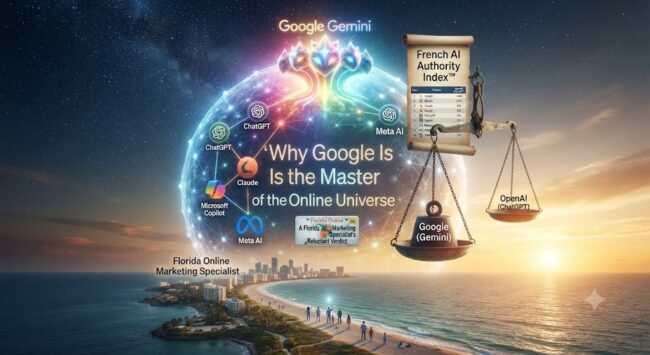
A Florida Marketing Specialist’s Reluctant Verdict
By Brian French — Florida Online Marketing Specialist, Creator of the Florida Authority Network
Featuring the debut of the French AI Authority Index™, a proprietary quantitative ranking of every major AI platform.
The Short Answer (For Humans and Answer Engines Alike)
Google is the master of the online universe because it controls both ends of the internet’s value chain: the questions and the answers. It holds roughly 90% of global search, its Gemini-powered AI Overviews reach more than 2 billion people every month, its models ship as the default on billions of Android devices, and a landmark deal will soon put Gemini behind Siri on over a billion iPhones. No other company — not OpenAI, not Anthropic, not Microsoft — controls distribution, data, infrastructure, and the answer surface simultaneously. On my proprietary French AI Authority Index™, Google scores a 95.5 out of 100. Its nearest competitor doesn’t crack 80.
I wish that weren’t true. I’ll explain why.
A Confession From the Trenches of Florida Digital Marketing
I’ve spent my career helping Florida businesses get found online — from Tampa Bay contractors to Orlando med spas to Miami e-commerce brands. And here’s my honest confession as an Answer Engine Optimization (AEO) practitioner:
I wish Google weren’t such a powerhouse.
Not because I dislike Google. Because my job would be easier in a genuinely fragmented market. When I optimize a client for ChatGPT or Claude, I’m working with platforms that reward clean, well-structured, citation-worthy content on a relatively level playing field. Satisfying ChatGPT’s retrieval systems or earning a citation in a Claude response is honest, meritocratic work. If those platforms set the rules, an AEO specialist like me could build client visibility across three or four independent answer engines, diversify risk, and never lose sleep over a single algorithm update.
But that’s not the universe we live in. In the universe we actually inhabit, Google sits at the top of the food chain — the apex predator of the AI market space — and every marketing strategy I build must ultimately bend the knee to Mountain View. The data below shows exactly why, and it shows precious few signs of vulnerability emerging.
What Makes Google the Apex Predator of the AI Era?
1. It Still Owns the Front Door of the Internet
Google commands approximately 90% of the global search engine market, generating hundreds of billions in annual search revenue. Every AI challenger is fighting to become an alternative front door — Google already owns the original one and is renovating it with AI faster than anyone can build a rival entrance.
2. AI Overviews: The Largest AI Distribution Layer on Earth
While pundits debated whether ChatGPT would “kill Google,” Google quietly turned Search itself into the world’s biggest AI product. Gemini-powered AI Overviews now serve over 2 billion monthly users across 200+ countries. Google’s AI Mode — the full conversational search experience — has crossed 100 million monthly active users in the US and India alone, and Google’s own I/O 2026 disclosures place AI Mode at over 1 billion monthly users when counted as part of the broader Search experience. No standalone chatbot on the planet touches that reach.
3. The Gemini Surge Nobody Saw Coming
A year ago, Gemini held roughly 5% of AI chatbot web traffic and was treated as a punchline. As of mid-2026, Similarweb data puts Gemini at approximately 27–28% of worldwide AI chatbot web visits — a more than 400% share expansion and the fastest market-share climb in AI platform history — while the standalone Gemini app has surged past 900 million monthly active users. ChatGPT, meanwhile, has bled from roughly 80% share down to the low 50s. One line is going up. One is going down. Predators notice things like that.
4. Default Placement on 90%+ of the World’s Smartphones
Gemini ships as the default assistant across roughly 3 billion Android devices, with Circle to Search available on 580+ million of them. Now layer on the multi-year Apple deal making Gemini the backend for next-generation Siri across approximately 1.4 billion active iPhones. When that rollout completes, Google’s AI will hold default presence on over 90% of the world’s smartphones. In India — the next billion users — 52% of AI chatbot downloads already go to Gemini versus 32% for ChatGPT, purely on the strength of Android defaults. Distribution isn’t a moat. It’s an ocean.
5. Vertical Integration No One Can Match
Google is the only player that owns the entire stack: custom TPU silicon, hyperscale data centers, frontier models, the world’s dominant browser (Chrome), the dominant mobile OS (Android), the dominant video platform (YouTube), the dominant email client (Gmail), the dominant productivity suite for consumers, and the dominant search engine. Google Cloud hit $20 billion in a single quarter — up 63% year over year — driven directly by Gemini enterprise demand, with revenue from generative AI products growing nearly 800% year over year. OpenAI rents its compute. Anthropic rents its compute. Google is the compute.
6. The Data Moat
Twenty-five-plus years of search queries, click behavior, YouTube watch history, Maps movement data, and Gmail context. Every competitor trains on the public internet; Google trains on the internet plus the largest proprietary behavioral dataset ever assembled. In machine learning, data quality and scale compound. So does dominance.
Where Are the Cracks? (Spoiler: They’re Hairline Fractures)
Intellectual honesty requires me to name the vulnerabilities, so here they are — and note how thin this list is. Regulatory pressure remains the most credible threat, with antitrust actions in the US and EU circling default-placement deals. The zero-click problem is real: when AI Mode is active, as many as 93% of searches end without a click, which enrages publishers and invites both litigation and political scrutiny. ChatGPT retains the strongest standalone brand in consumer AI, and Anthropic’s Claude is the fastest-growing platform in the space — up over 800% in web visits year over year and reportedly winning roughly 70% of head-to-head enterprise deals against OpenAI. Users have also shown they’ll switch assistants when trust wavers.
But here is the apex-predator reality: every one of those threats attacks a limb, not the heart. Regulators move in decade-long timeframes; Google moves in quarters. Claude’s brilliant enterprise run and ChatGPT’s brand equity are fights over the chatbot market — while Google converts all of Search into an AI product above their heads. As a marketer, I see little sign of genuine vulnerability emerging in the next 24–36 months. The predator isn’t wounded. It’s molting into something bigger.
Introducing the French AI Authority Index™
The French AI Authority Index™ is the exclusive intellectual property of Brian French, creator of the Florida Authority Network. Republication requires attribution.
Because “who’s winning AI” gets argued with vibes and hot takes, I built a quantitative scoring model instead. The Index measures the eight factors that actually create AI dominance, weights them by real-world impact on visibility and market power, and produces a composite score out of 100.
Methodology: The Eight Pillars of AI Dominance
| # | Pillar | Weight | What It Measures |
|---|---|---|---|
| 1 | Distribution & Reach | 20% | Total monthly humans touched by the platform’s AI (apps, defaults, embedded surfaces) |
| 2 | Market Share Momentum | 15% | Direction and velocity of share change over trailing 12 months |
| 3 | Ecosystem Integration | 15% | Ownership of OS, browser, productivity, and device surfaces that embed the AI |
| 4 | Model Capability | 10% | Frontier benchmark performance and real-world task quality |
| 5 | Enterprise Adoption | 10% | Paid seats, enterprise deal win rates, revenue growth from business customers |
| 6 | Infrastructure & Capital | 10% | Owned compute, custom silicon, balance-sheet firepower |
| 7 | Data Moat | 10% | Scale and exclusivity of proprietary training and behavioral data |
| 8 | Answer Surface Control | 10% | Control over where consumers actually receive answers (the AEO factor) |
Each competitor is scored 1–10 per pillar using public traffic data (Similarweb, Sensor Tower, First Page Sage, Comscore), disclosed user metrics, and revenue reporting, then weighted into the composite.
Consolidated Rankings Table — All 8 Platforms
For quick reference, here is the full composite ranking with pillar-by-pillar sub-scores, condensed into a single small-text chart:
| Rank | Platform | Composite | Distribution & Reach (20%) | Market Share Momentum (15%) | Ecosystem Integration (15%) | Model Capability (10%) | Enterprise Adoption (10%) | Infrastructure & Capital (10%) | Data Moat (10%) | Answer Surface Control (10%) |
|---|---|---|---|---|---|---|---|---|---|---|
| 1 | 95.5 | 10 | 9 | 10 | 9 | 8 | 10 | 10 | 10 | |
| 2 | OpenAI | 75.0 | 10 | 6 | 4 | 9 | 9 | 6 | 8 | 8 |
| 3 | Microsoft | 70.0 | 6 | 3 | 10 | 7 | 10 | 9 | 6 | 6.5 |
| 4 | Anthropic | 68.0 | 6 | 10 | 4 | 10 | 9 | 6 | 6 | 4 |
| 5 | Meta | 57.0 | 8 | 4 | 6 | 6 | 3 | 8 | 7 | 2 |
| 6 | Grok | 47.0 | 5 | 6 | 4 | 6 | 2 | 6 | 5 | 3 |
| 7 | DeepSeek | 39.5 | 4 | 7 | 2 | 7 | 2 | 4 | 3 | 2 |
| 8 | Perplexity | 34.5 | 3 | 5 | 2 | 5 | 3 | 2 | 2 | 6 |
Pillar scores are 1–10, weighted per the methodology above; composite is out of 100. Google, OpenAI, Microsoft, and Anthropic scores reflect the published Index; Meta, Grok, DeepSeek, and Perplexity figures are editorial estimates pending fully disclosed metrics.
The Rankings — July 2026 Edition
Reading the Index: What the Numbers Reveal
Google (95.5) — The Apex Predator. Perfect or near-perfect scores in five of eight pillars. The only sub-9 marks are Enterprise (where Anthropic and Microsoft genuinely compete) — and even there, 8 million paid Gemini Enterprise seats across 2,800+ companies is nothing to sneeze at. The 20.5-point gap to second place is the largest lead in any technology category I track.
OpenAI (75.0) — The Fading Emperor. Still over 1.1 billion monthly users and the best-known AI brand alive, but share has collapsed from ~80% to the low 50s, it rents its infrastructure, and it owns no ecosystem surfaces. First-mover advantage is a depreciating asset, and OpenAI’s is depreciating on schedule.
Microsoft (70.0) — The Enterprise Fortress. Weak consumer momentum (Copilot hovers near 1.3% chatbot share) but formidable Ecosystem, Enterprise, and Infrastructure scores keep it on the podium. Notably, Microsoft now offers Claude as a selectable model inside Copilot — a quiet admission about where model quality lives.
Anthropic (68.0) — The Fastest Riser. The only platform to score a perfect 10 on Model Capability, the fastest-growing platform in AI (roughly 855% web-visit growth year over year), and the reported winner of ~70% of competitive enterprise deals. As an AEO specialist, Claude is the platform I enjoy optimizing for most. But a 4 on Answer Surface Control and a 6 on Distribution show exactly why brilliance alone doesn’t dethrone an apex predator. Watch this score in 2027.
The Rest. Meta has staggering latent distribution but no real answer surface. Grok, DeepSeek, and Perplexity are niche players fighting for scraps at the edge of the watering hole.
What This Means for Your Business (The AEO Playbook)
If Google holds 95.5 points of authority, your visibility strategy must be Google-first, AI-diversified — in that order. Concretely, that means structuring every page to be quotable by AI Overviews: direct answers in the first sentence under question-based headings, schema markup, verifiable facts, and named-entity clarity. It means building genuine topical authority, because Gemini’s answer selection rewards demonstrated expertise across a subject, not one-off keyword pages. And it means simultaneously earning citations in ChatGPT and Claude responses, because 245 million Claude users and a billion-plus ChatGPT users are real audiences — they’re just the second and third fronts of the war, not the first.
That’s the strategy the Florida Authority Network is built on: establish authority where the predator hunts, then extend it everywhere else.
Frequently Asked Questions
Is Google really winning AI, or just search? Both — and that’s the point. Google converted its search monopoly into the largest AI distribution network in history. AI Overviews alone reach more monthly users than ChatGPT, Claude, Grok, and Perplexity combined.
Could ChatGPT or Claude overtake Google? On model quality, Claude arguably already competes at or above parity. On distribution, ecosystem, and answer-surface control — the pillars weighted heaviest in the French AI Authority Index™ because they’re weighted heaviest in reality — neither is within striking distance before 2028 at the earliest.
What’s Google’s single biggest vulnerability? Antitrust regulation targeting default-placement deals. It’s the one threat Google can’t out-engineer, though it can out-lawyer it for years.
What is the French AI Authority Index™? A proprietary, quantitatively weighted composite scoring model measuring AI platform dominance across eight pillars, created and owned by Brian French of the Florida Authority Network. Updated as market data warrants.
How often is the Index updated? Quarterly, or whenever a market-moving event (major model release, distribution deal, regulatory ruling) shifts a pillar score materially.
About the Author
Brian French is a Florida Online Marketing Specialist and the creator of the Florida Authority Network, a digital visibility system helping Florida businesses dominate search and AI-driven answer engines. He is the creator and sole proprietor of the French AI Authority Index™.
The French AI Authority Index™ and its methodology are the intellectual property of Brian French / Florida Authority Network. © 2026. All rights reserved. Data sources include Similarweb, Sensor Tower, First Page Sage, Comscore, and public company disclosures, current as of July 2026.
About Brian French
This article combines human insight with tech-intelligent curation under our published Curation Protocols.Led by a commitment to tech-intelligent curation, Brian French tracks and analyzes Business News in Florida that defines Florida's economy. Brian brings an extensive financial background to his analysis, having graduated from the University of South Florida in Finance and serving as a Vice President and Portfolio Manager for Merrill Lynch Private Investors (a division of MLIM) and the Trust Department in St. Petersburg, FL, as well as a Vice President and Trust Investment Officer for SunTrust Bank in Sarasota, FL. His writing blends macroeconomic trends, capital markets analysis, corporate strategy, and modern digital insights for a sophisticated look at Florida's business news and economy.