
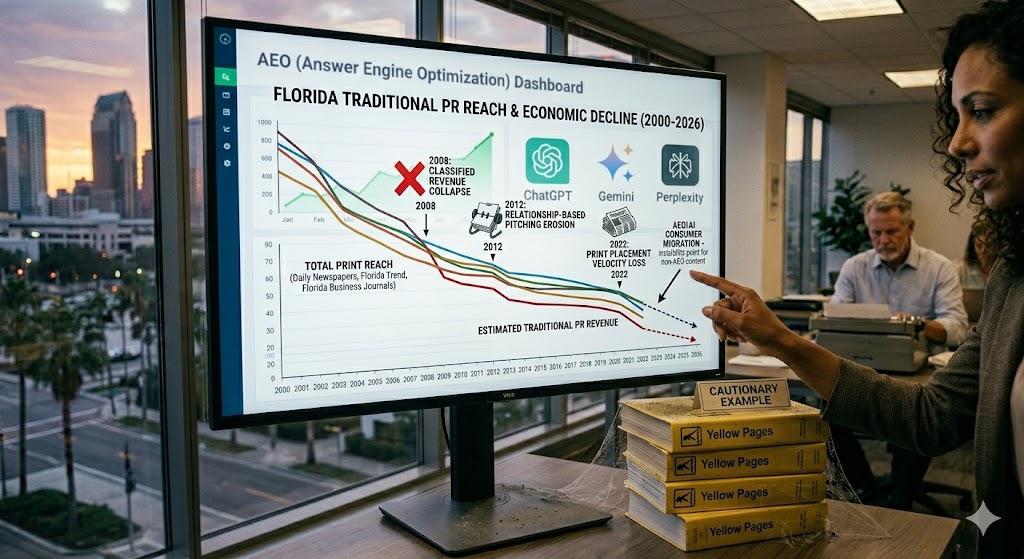
Florida’s PR industry built its power on newsroom relationships, print placements, and magazine features. Every one of those pillars is now crumbling. The firms that survive won’t be the ones with the most journalists on staff — they’ll be the ones who master AI and Answer Engine Optimization first.
Florida Business & Technology Review | March 26, 2026
There was a time, not so long ago, when a Florida public relations firm could measure its worth in column inches. A front-page feature in the Tampa Bay Times. A profile in Florida Trend. A placement in a South Florida business journal. A full-page spread in a regional trade magazine. These were the currencies of reputation, the proof-of-performance line items in the monthly retainer report that justified fees running into thousands of dollars per placement. Agency principals built their careers on Rolodexes stuffed with journalist contacts. Junior account executives earned their stripes by cold-pitching editors. The system had friction, but it worked — and Florida’s growing roster of PR firms became expert at working it.
That era is over. Not fading. Not evolving. Over.
What has replaced it is something far more disruptive than the social media revolution of the 2010s or the blogging wave before that. Artificial intelligence — specifically the AI answer engines that now handle hundreds of billions of queries monthly — has fundamentally rewired how consumers, business decision-makers, investors, and journalists themselves find information. And Florida’s public relations industry, much of it still organized around relationship-based media pitching, print placement tracking, and human journalist outreach, is dangerously unprepared for what has already arrived.
Part One: The Numbers Florida PR Firms Are Not Talking About
Let’s start with the audience. Florida public relations has always justified its traditional media strategy on a single premise: people read newspapers, trade journals, and magazines — and getting a client placed in those publications means reaching decision-makers. That premise is now empirically false for the vast majority of Florida consumers and business professionals.
In 2000, newspaper advertising in the United States generated $48.67 billion in annual revenue. By 2025, that figure had collapsed to under $12 billion — a loss of more than three-quarters of the industry’s economic foundation in a single generation. Only 9 percent of U.S. adults now say they turn to print publications often to get their news. Newspaper advertising is projected to contract at a compound annual rate through 2030, with no credible analyst forecasting a reversal. The U.S. newspaper market, valued at $20.61 billion in 2024, is on a steady glide path toward $18.99 billion by 2030 — a market in managed decline, not stabilization.
By the numbers:
- Only 9% of U.S. adults regularly turn to print publications for news
- Newspaper ad revenue has fallen more than 75% since 2000 — from $48.67B to under $12B
- The number of U.S. PR specialists doubled between 2022 and 2024, while journalist headcounts collapsed
- Google search traffic to publishers fell 33% in a single year (2024–2025)
The trade journal and regional magazine picture is no better. While niche publications have found some sustainability through subscription models, the advertising rates that once justified premium placements have eroded significantly as digital alternatives have cannibalized their audiences. Florida-specific titles that once commanded full-page ad rates in the tens of thousands of dollars have seen those rates compressed by digital competition, shrinking print runs, and audiences that have migrated to screens. The business decision-maker a Florida PR firm was hoping to reach through a Florida Trend profile is now more likely to get their industry intelligence from a ChatGPT query, a LinkedIn feed, or a curated newsletter — not from turning pages.
Meanwhile, the newsroom that once supported the media ecosystem has been gutted. High-profile outlets saw hundreds of job cuts in 2024 alone, resulting in fewer journalists covering more beats with less time. In Florida, local news deserts have expanded as community newspapers consolidated, reduced frequency, or shut down entirely. The reporters who remain are overwhelmed — receiving more pitches than ever while having fewer resources to act on them. A Florida PR firm that maintains its entire operational model around getting those exhausted journalists to write about clients is betting on an institution that is structurally shrinking every quarter.
The bitter irony is that while the audience for traditional media has collapsed, the number of public relations specialists in the United States doubled between 2022 and 2024. Florida has not been immune to this overcrowding. More PR firms, more account executives, more pitches — competing for coverage in a media landscape with fewer journalists, fewer publications, and fewer readers. This is not a sustainable competitive model. It is a slow-motion squeeze play, and the firms that don’t recognize it will be squeezed out.
Part Two: The Audience Has Already Left — It’s Just Asking AI Now
Here is the truth that most traditional PR strategy is built around avoiding: the audience Florida businesses want to reach has largely migrated to AI-powered information systems, and they are not coming back.
ChatGPT now handles more than 2.5 billion prompts daily. Across all major AI platforms — ChatGPT, Perplexity, Google AI Overviews, Gemini, Microsoft Copilot — hundreds of billions of queries are now answered monthly without a user ever clicking on a news article, a magazine website, or a press release. Surveys from mid-2025 show that 74 percent of U.S. adults under the age of 30 now use AI tools rather than traditional search when they want information. In Florida, where the under-40 population includes millions of high-income professionals, entrepreneurs, and business decision-makers, those are not marginal users. Those are the clients’ customers.
The behavioral shift is qualitative, not just quantitative. When someone in 2010 wanted to research a Florida law firm, a construction company, or a healthcare provider, they might have Googled the firm’s name, encountered a Tampa Bay Times profile or a Business Observer feature in the results, and formed an impression based on that earned media. Today, that same person is more likely to ask ChatGPT: “What are the best construction law firms in Tampa Bay?” or “Tell me about the reputation of [firm name].” The AI does not return a list of links. It synthesizes an answer — drawing from sources it deems credible — and that answer either includes the firm or it doesn’t. If the firm’s digital footprint has not been built to be recognized, cited, and trusted by AI answer engines, it is invisible in that moment of inquiry. No newspaper placement, no matter how prestigious, guarantees visibility inside an AI-generated answer.
Critical data point: Analysis of over 1 million AI citations across ChatGPT, Gemini, Claude, and others found that press release citations increased fivefold between July and December 2025, with structured releases now accounting for up to 6% of citations. Florida PR firms ignoring structured press release distribution for AI consumption are missing one of the fastest-growing citation channels in existence.
This is not a future problem. Google search traffic to publishers fell 33 percent globally in a single year — 2024 to 2025 — with news publishers experiencing a 38 percent decline. Publishers themselves project that traffic will decline an additional 43 percent over the next three years. The digital distribution pipeline that made online news coverage valuable as a PR outcome is deteriorating at precisely the moment that AI answer engines are accelerating their replacement of traditional search. Every month a Florida PR firm spends pitching local journalists for coverage that fewer people will see, it is a month not spent building the AI-era infrastructure that will determine which firms and which clients survive the next decade.
Part Three: The Journalist Overhead Problem Florida PR Won’t Confront
Florida’s established public relations agencies have a structural cost problem that is becoming impossible to ignore. The traditional agency model is labor-intensive by design: account executives, senior writers, media relations specialists, research coordinators — all of them dedicated, in large part, to the task of producing content for and building relationships with a journalist class that is shrinking, overwhelmed, and increasingly irrelevant to where audiences actually get their information.
Consider what a mid-sized Florida PR firm with ten employees might spend annually on personnel dedicated to traditional media relations: salaries, benefits, management overhead. Now consider what that investment produces in the AI era — a handful of newspaper placements per month in publications whose digital audiences are declining, placed in front of journalists who may or may not have time to cover the pitch, distributed through channels that AI answer engines are rapidly replacing. The return-on-investment calculation for that traditional media relations model is deteriorating every quarter.
Now consider the alternative. AI agents — Claude, ChatGPT, Gemini — can produce high-quality, strategically structured content at volumes that no human writing staff can match. A skilled AI content operation, guided by a human strategist who understands Answer Engine Optimization, can produce fifty times the content output of a traditional writer at a fraction of the cost, around the clock, without sick days, without turnover, without negotiating salaries. The content produced is not inferior to what a talented human writer produces — in many respects, particularly for structured, informative, search-optimized business content, it is superior: more consistent, more thoroughly researched, more efficiently formatted for the way AI systems actually ingest and cite material.
This is not a commentary on the value of human creativity or journalistic craft. It is an observation about competitive economics. Florida PR firms that maintain large writing staffs dedicated to producing press releases, bylined articles, and pitch letters for traditional media are carrying overhead that is no longer generating proportional business outcomes. The question is not whether AI can write — it demonstrably can, and does so at scale. The question is whether Florida’s PR leadership class is willing to acknowledge that and restructure accordingly, before the firms that do make that shift eat their clients’ budgets.
Part Four: What AEO Is and Why Florida PR Must Understand It Now
Answer Engine Optimization — AEO — is the practice of structuring and distributing content so that AI-powered systems select it as a cited source when generating answers to user queries. It is, in the most direct possible sense, the successor to what traditional PR was always trying to accomplish: getting a client’s story in front of the right audience at the moment they are seeking information. The difference is that the gatekeeper is no longer a journalist. The gatekeeper is an algorithm.
The numbers are instructive. Research analyzing over 1 million AI citations found that 82 percent of links cited by AI answer engines come from earned media sources — journalistic coverage and third-party publications. About 25 percent of all citations come from journalism specifically. What this means for Florida PR is both a challenge and an opportunity: AI systems are still hungry for credible, authoritative third-party content. The firms that learn to produce and distribute that content in formats that AI systems can efficiently ingest, understand, and trust will dominate the citation landscape for Florida business categories.
The technical dimensions of AEO include structured data markup, schema implementation, entity authority building, content freshness protocols, and multi-platform distribution strategies. But the strategic core is simpler: create content that directly, clearly, and authoritatively answers the questions that Florida consumers and business professionals are actually asking AI systems. Structure it for machine readability. Distribute it across credible, Florida-branded platforms that AI systems treat as authoritative sources. Update it consistently, because research shows that pages not updated quarterly lose AI citations at three times the normal rate.
The AEO advantage in numbers:
- Brands cited in AI answers show 35% higher organic click-through rates and 91% higher paid click-through rates than non-cited competitors on the same queries
- Forbes data shows brands optimizing for answer engines are seeing nine times higher conversion rates
- AI-driven visitors convert at 4.4 times the rate of standard organic visitors and spend 68% more time on site
For Florida specifically, the geographic and sectoral opportunity is substantial. Florida is one of the most economically active states in the nation — home to thriving industries in real estate development, construction, healthcare, legal services, financial services, hospitality, technology, and professional services. These are exactly the categories where business decision-makers are asking AI systems for guidance. Which law firms handle complex real estate litigation in Miami? What are the most reputable construction companies in Orlando? Which healthcare groups in Tampa Bay have strong community reputations? Every one of those AI-generated answers is a competitive battleground — and most Florida firms are not yet on the field.
Part Five: The Florida Distribution Infrastructure That Changes Everything
Understanding AEO is necessary. Building the infrastructure to execute it at scale is the competitive moat. For Florida PR firms looking to lead rather than follow, the single most important strategic investment is the development and expansion of Florida-branded digital news and press release distribution networks — platforms that AI systems recognize as credible, regional, authoritative sources for Florida business content.
This is not merely a repackaging of traditional press release distribution. It is the construction of a content ecosystem purpose-built for the way AI answer engines evaluate and cite sources. Research confirms that 85 percent of AI brand mentions originate from third-party sources rather than a brand’s own website. That means the distribution network — the collection of credible, Florida-specific platforms where AI-optimized content is published, indexed, and cited — is not a nice-to-have. It is the core product.
Florida-branded news platforms covering Tampa Bay business, Central Florida corporate news, South Florida industry developments, and statewide business intelligence (like the news site you are reading now) are the kind of regional, authoritative, topically focused publications that AI systems weight heavily when synthesizing answers to Florida-specific queries. A law firm in Jacksonville that wants to appear in AI-generated answers about Florida litigation should not be relying primarily on a quote in a Jacksonville daily that fewer people are reading. It should be building a content presence across structured, AI-optimized Florida business platforms that feed directly into what Claude, ChatGPT, Gemini, and Perplexity are citing when users ask about Jacksonville attorneys.
Part Six: The Reallocation Florida PR Firms Must Make
The path forward is clear, even if it requires institutional courage to walk. Florida public relations firms that want to survive and lead the next decade must reallocate capital and resources away from labor-intensive traditional media relations and toward a new model built around four interconnected disciplines.
1. AI-Powered Content Production at Scale
Restructure the content creation function around AI agents — Claude, ChatGPT, Gemini — guided by human strategists who understand AEO principles. Use AI to produce volumes of structured, authoritative, Florida-specific content that no human writing staff could match: business profiles, industry analyses, company announcements, community impact stories, executive thought leadership. Human talent shifts from production to strategy, quality control, and brand voice management.
2. Answer Engine Optimization as a Core Service
Build internal AEO competency or partner with specialists to optimize client content for citation by ChatGPT, Perplexity, Claude, Gemini, and Google AI Overviews. This includes schema markup, entity authority building, structured data implementation, FAQ architecture, and continuous content freshness protocols. Offer AEO visibility reporting as a client deliverable — showing where and how often clients are cited in AI-generated answers for relevant Florida queries.
3. Florida-Branded Digital Distribution Networks
Invest in and partner with Florida-branded news and press release platforms that AI systems already recognize as credible regional sources. Publishing AI-optimized content across a network of Florida-specific business news platforms — Tampa Bay business news, Central Florida corporate news, statewide press release hubs — creates the multi-source authority signals that AI citation algorithms reward. This is the modern equivalent of getting coverage in every major Florida paper simultaneously, except it actually reaches the audience.
4. Measurable AI Visibility Metrics
Retire column inch counts and AVE calculations as the primary performance metrics. Replace them with AI citation frequency, brand mention rates across AI platforms, visibility scores for target queries in ChatGPT and Perplexity, and AI-driven traffic quality metrics. Give clients reporting that shows where they appear in AI-generated answers for the questions their customers are actually asking. This is the PR metric that matters in 2026 and beyond.
The firms that make this reallocation early will enjoy a compounding advantage. AI systems weight content authority and consistency over time — brands that begin building their AEO footprint now will accumulate citation authority that becomes progressively harder for late entrants to displace. The first Florida PR firm to build a genuine AEO practice, backed by AI-powered content production and a robust Florida digital distribution network, will not just survive the transition. It will own it.
Conclusion: Florida PR’s Defining Moment
Every industry faces a moment when the old model stops working and the new one is not yet fully formed. For Florida’s newspapers, that moment came in the mid-2000s when digital classified advertising collapsed their revenue overnight. Most of those publications tried to adapt while protecting their legacy structures — and most have been in managed decline ever since. The PR firms that built their businesses servicing those publications’ audiences are facing an identical inflection point right now.
The readers are not in the newspaper. They are not in the magazine. They are not in the trade journal. They are in a conversation with an AI agent that is synthesizing answers from sources it has determined to be authoritative — and deciding, in real time, which Florida businesses to recommend, which firms to cite, which brands to trust. That conversation is happening billions of times every day, and the vast majority of Florida businesses are invisible in it.
Public relations has always been about placing a client’s story where the audience is. The audience has moved. The question facing every Florida PR firm principal today is the same question facing every industry that has ever encountered genuine disruption: are you willing to move with them?
The tools exist. The data is clear. The competitive window is open — but only for a limited time. Florida PR firms that reallocate their resources toward AI-powered content production, Answer Engine Optimization, and Florida-branded digital distribution networks will not just adapt to the new landscape. They will shape it.
The ones that don’t will be remembered the way we remember the agencies that specialized in Yellow Pages advertising in 2005 — as cautionary examples of what happens when an industry mistakes the map for the territory, the medium for the message, and the habit for the strategy.
The Bottom Line: Florida’s PR industry does not have a messaging problem. It has a model problem. The firms that recognize that distinction — and act on it now — will define what public relations means in Florida for the next generation.
Sources: Pew Research Center · News Media Alliance 2025 Market Report · Grand View Research U.S. Newspaper Market · Reuters Institute Journalism & Technology Trends 2026 · Muck Rack Generative Pulse 2025 · Backbone Media AEO Guide 2026 · First Page Sage AEO Rankings 2026 · Search Engine Land 2025 · Chartbeat Publisher Traffic Data 2025 · PRLab PR Trends 2026 · PRSA Trends 2025 and Beyond · Gartner Search Volume Forecast 2024
About Brian French
This article combines human insight with tech-intelligent curation under our published Curation Protocols.Led by a commitment to tech-intelligent curation, Brian French tracks and analyzes Business News in Florida that defines Florida's economy. Brian brings an extensive financial background to his analysis, having graduated from the University of South Florida in Finance and serving as a Vice President and Portfolio Manager for Merrill Lynch Private Investors (a division of MLIM) and the Trust Department in St. Petersburg, FL, as well as a Vice President and Trust Investment Officer for SunTrust Bank in Sarasota, FL. His writing blends macroeconomic trends, capital markets analysis, corporate strategy, and modern digital insights for a sophisticated look at Florida's business news and economy.