By Brian French
Time marked: Written March 20th 2026 of our Lord.
Tick. Tick. Tick. Something is coming that humanity has never seen before. We just can’t agree on what it will be — or exactly when the clock will first chime.
We Have Never Had Tools Like This Before
Every generation believes it lives at the hinge of history. Most are wrong. The printing press crowd was right. The industrial revolution crowd was right. The nuclear age crowd was right, for better and worse. And the people quietly watching AI infrastructure being assembled at a scale that dwarfs every previous technological buildout in human history — they are right too.
But here is what makes this moment genuinely different from every other technological leap: we have never, in the entire recorded history of our species, possessed reasoning tools this powerful. Not even close.
When Einstein worked out the theory of general relativity, he had a pencil, a notebook, and a brain running on roughly 20 watts of biological power. When Watson and Crick unraveled the structure of DNA, they had a rotating metal model and a few X-ray photographs. When the Manhattan Project scientists split the atom, they were doing the math by hand, on chalkboards, passing paper between rooms.
In the next 24 months, the intelligence available to the scientists, engineers, doctors, and researchers working on the hardest problems in human history will not be 10 times greater than Einstein’s pencil. It will not be 100 times greater. It will be millions of times greater — running continuously, never sleeping, never losing focus, never forgetting a single research paper published anywhere on Earth in any language.
The question is not whether breakthroughs will come. The question is which miracle arrives first.
“For the first time in history, the bottleneck is not intelligence. We have more of that than we know what to do with. The bottleneck now is simply: which problem do we point it at?”
Tick. The Clock Has Already Started.
Most people picture AI progress the way they picture a plane at cruising altitude — steady, predictable, occasionally bumpy. What is actually happening looks more like a rocket still in the first thirty seconds of launch. The acceleration is not linear. It is compounding. And the compounding is now entering the phase where the numbers become genuinely difficult for human intuition to process.
Consider what happened just between 2023 and today. AI systems went from struggling to pass the bar exam to outperforming the median human attorney. They went from generating plausible-sounding medical advice to diagnosing rare diseases that stumped specialists for years. They went from writing passable code to designing entire software architectures that engineers then refine and deploy.
And that was on the hardware of two generations ago.
Blackwell is now being deployed at scale. Vera Rubin arrives in the second half of 2026 with ten times the inference performance at one-tenth the cost per token. The AI systems being trained on that hardware — systems we have not yet seen, running on architectures still being designed — will make today’s most capable models look like the hand-cranked calculator looked next to the first mainframe.
Something extraordinary is going to happen. Probably more than one something. The clock is not counting down to a maybe. It is counting down to a when.
The First Miracle: A Cancer Surrenders
There are roughly 100 distinct types of cancer. Each one is, at its core, a protein-folding problem — a set of molecular interactions gone wrong in ways that, until recently, we lacked the computational power to fully map, model, and reverse-engineer.
In 2020, DeepMind’s AlphaFold solved one of the greatest open problems in biology: predicting how a protein folds from its amino acid sequence. A problem that had defeated biochemists for fifty years fell in a single research cycle. The scientific community called it one of the most significant breakthroughs in the history of biology.
That was the opening act.
What comes next is an AI system with ten, fifty, a hundred times that capability — trained not just on protein structures but on the complete global literature of oncology, genomics, clinical trial outcomes, and patient records — working continuously on a specific cancer subtype, generating and testing hypotheses at a rate no human research team could sustain for a single hour.
The first cancer that falls will not be announced with the drama it deserves. There will be a paper. Then a clinical trial. Then a press release from a pharmaceutical company or a university hospital. And then, slowly, the world will begin to understand that the wall that killed millions of people over thousands of years just came down.
When that happens — not if, when — every other disease will look different to every researcher on Earth. Because the same tools that solved cancer subtype one will be immediately retrained on cancer subtype two. And Alzheimer’s. And ALS. And the hundred other conditions that have defied human medicine for generations.
The first miracle is likely a medical one. And it is very probably already being discovered in a lab right now, by a research team that doesn’t fully realize yet what they have.
The Second Miracle: Energy Becomes Almost Free
The greatest constraint on human prosperity is not capital, not labor, and not land. It is energy. Everything — food, manufacturing, transportation, heating, cooling, computation itself — is ultimately a function of how much energy you can produce, store, and move efficiently.
Fusion energy has been “thirty years away” for seventy years. Materials science has been inching toward room-temperature superconductors for decades. Battery chemistry has been fighting the same tradeoffs between energy density, charge speed, and cycle life since the 1970s.
These are not unsolvable problems. They are problems that have been constrained by the pace at which human researchers can generate, test, and learn from hypotheses. AI removes that constraint almost entirely.
An AI system with access to the complete literature of materials science, chemistry, and physics — running on Vera Rubin-class hardware at millions of inference steps per second — can explore the space of possible molecular configurations, alloys, and superconducting materials at a rate that would take conventional research centuries to cover. It can design an experiment in the morning, analyze the results by afternoon, and generate the next fifty hypotheses before the lab technician finishes their coffee.
The breakthrough in energy will not announce itself gently. When a new battery chemistry achieves ten times the energy density at one-tenth the cost of lithium-ion, every electric vehicle, every grid-scale storage system, and every solar installation on Earth is suddenly worth reconsidering. When a room-temperature superconductor is discovered and manufactured at scale, transmission losses that currently consume roughly 5–10% of all electricity generated simply disappear.
The era of abundant, nearly free energy is not a utopian fantasy. It is an engineering problem. And we are, for the first time, building tools powerful enough to solve it.
“Fusion has been thirty years away for seventy years. It has never been thirty years away with this much intelligence pointed at it.”
The Third Miracle: The Roads Empty of Human Error
Every year, approximately 1.35 million people die in road accidents globally. Nearly all of them die because a human being — tired, distracted, impaired, or simply unlucky — made a mistake at precisely the wrong moment.
Self-driving vehicles have been “five years away” for fifteen years, for the same reason fusion has been thirty years away: the computational models weren’t good enough, the training data wasn’t rich enough, and the real-world edge cases were too numerous for traditional software to handle. Every time a rare scenario emerged — a mattress on the highway, a child chasing a ball between parked cars at dusk — it exposed another gap in the model.
AI systems trained on Blackwell and Vera Rubin hardware are closing those gaps faster than they can be catalogued. The long tail of edge cases that once seemed infinite is being consumed. The models are not being patched; they are developing genuine situational reasoning — the ability to handle scenarios they have never seen before by understanding the underlying physics and intent of the world around them.
The moment a major metropolitan area launches a fully autonomous commercial fleet — no safety driver, no remote operator, operating 24 hours a day across the full complexity of an urban road network — the insurance industry will reprice overnight. City planners will begin redesigning roads that no longer need to accommodate human reaction times. Parking garages will become apartment buildings. And the 1.35 million people who would have died next year will not.
That is not a product launch. That is a civilization-level event disguised as a press release.
The Fourth Miracle: A Roof Over Every Head
The global housing crisis is, at its root, a design and logistics problem. The same house has been built roughly the same way — by hand, on-site, by skilled trades that are increasingly scarce — for over a century. Costs have risen faster than inflation in virtually every developed economy. Homelessness has grown even in the wealthiest cities on Earth.
AI-designed construction is not a futuristic concept. It is already beginning. Generative design systems are producing structural plans that use 30–40% less material while meeting or exceeding all safety standards. Robotic construction systems are laying foundations, framing walls, and finishing interiors with a speed and precision that human labor cannot match at scale. And AI-optimized supply chains are beginning to eliminate the waste and delays that drive up construction costs even before a nail is hammered.
The miracle here is not a single building. It is the moment when the cost curve breaks — when a well-designed, structurally sound, energy-efficient home can be delivered at a fraction of current cost, at a speed that can actually absorb the backlog of unmet housing demand that has accumulated across decades.
When that moment arrives, it will not look like a miracle to the economists. They will write papers about supply elasticity and market efficiency. But to the family who moves into a home they could not have afforded two years earlier, it will feel exactly like one.
The Fifth Miracle: The Clock Running Inside Us Slows Down
Aging is not a mystery. It is a process — a specific, mechanistic, increasingly well-understood set of biological events involving telomere shortening, mitochondrial dysfunction, senescent cell accumulation, and epigenetic drift. We know what is happening. We have known the broad outlines for decades. What we have lacked is the computational power to identify, test, and sequence the interventions precisely enough to reverse or dramatically slow those processes in living organisms.
AI changes that calculus completely.
Gene therapies that target the specific molecular signatures of cellular aging, designed by AI systems that can model the downstream effects of every intervention across millions of cell types and biological pathways simultaneously, are not science fiction. They are in early trials today, produced by research teams working with AI tools that are a fraction of what will be available in 24 months.
The first anti-aging therapy that demonstrably extends healthy human lifespan — not marginally, but meaningfully — will trigger a cascade that makes every other development in this article look modest by comparison. Every pharmaceutical company on Earth will retrain their research pipeline around it. Every government health system will begin rethinking what “elderly” means. Every actuarial table ever written will be obsolete.
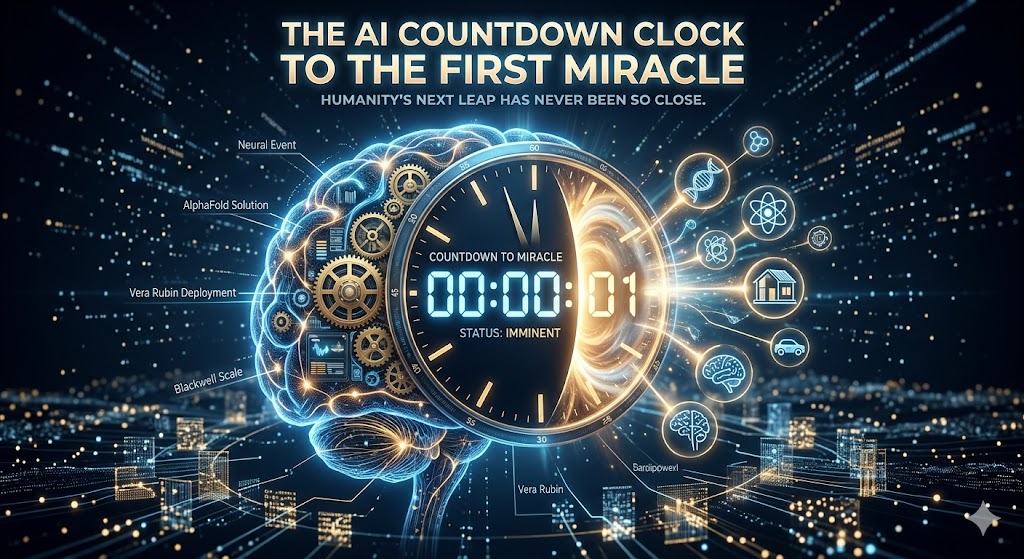
The clock ticking on the cover of this article runs in two directions. One counts down to the breakthrough. The other — if the breakthrough comes — may start running a great deal more slowly for all of us.
“We are not trying to live forever. We are trying to stay healthy long enough for the next breakthrough to arrive. And the next breakthrough is getting very close.”
The Gold Rush That Will Make All Previous Gold Rushes Look Punk
In 1848, gold was discovered at Sutter’s Mill in California. Within two years, the population of San Francisco grew from 1,000 to 25,000. Within a decade, California had become a state, a railroad was being planned across the continent, and the economic center of gravity of the United States had permanently shifted.
The people who became wealthy in the Gold Rush were not always the miners. They were the people who sold the picks, the shovels, the denim jeans, and the whiskey. They were the people who owned the land the miners crossed. They were the people who built the banks that held the gold once it was found.
We are at Sutter’s Mill again. Except the gold is intelligence — limitless, infinitely reproducible, applicable to every domain of human activity simultaneously. And the people selling the picks and shovels are not wearing flannel. They are shipping GPU racks.
When the first miracle lands — when a cancer falls, or an energy breakthrough publishes, or a fully autonomous fleet launches, or an anti-aging therapy clears its Phase III trial — the financial markets will not respond gradually. They will reprice in hours. The companies that provided the computational infrastructure that made the breakthrough possible will not merely go up. They will be revalued as foundational utilities of a new civilization.
Consider what happened to oil companies after the combustion engine. Consider what happened to semiconductor companies after the personal computer. Consider what happened to cloud infrastructure companies after the smartphone. Each of those inflection points produced generational wealth for investors who understood early that the new infrastructure was not a trend — it was the permanent foundation of everything that would come next.
AI infrastructure is that foundation. NVIDIA is the most visible supplier of its most essential component. And Vera Rubin — with ten times the performance at one-tenth the cost of the previous generation — is about to make AI economically accessible at a scale that will drive adoption curves nobody has modeled yet.
Could NVIDIA’s stock increase fivefold in a single week? In isolation, that would sound absurd. In a world where an AI system just cured a major cancer, solved a fusion energy problem, or unlocked the first meaningful anti-aging intervention — in a world where every government on Earth simultaneously realizes they are either in this race or irrelevant to the future — it would not be the ceiling. It would be the starting point of the revaluation.
“The Gold Rush of the 19th century made a few thousand people rich. The AI Gold Rush will restructure the wealth of nations. The question is not whether to pay attention. It is whether you are already too late.”
The Government Starting Guns Are Already Firing
The United States announced Stargate — a $500 billion AI infrastructure commitment — with a tone that was almost casual, as if half a trillion dollars were a routine budget line. It is not. It is the largest single technology investment in the history of any government, and it will not be the last.
Saudi Arabia has committed over $100 billion to AI infrastructure. The UAE is building data centers at a pace that would have seemed implausible three years ago. The European Union, historically cautious about technology investment, is racing to avoid being shut out of the intelligence economy entirely. China has been investing for years and is accelerating. South Korea, Japan, India, and a dozen other nations have announced AI investment programs that, individually, would have been front-page news in any previous decade and are now barely noticed in the torrent of announcements.
When governments move like this — not one government, but all of them, simultaneously, with a sense of urgency that overrides traditional budget deliberation — it is because the people briefing them have made something clear: the nations that lead in AI will lead in everything else. Medicine. Energy. Defense. Manufacturing. Finance. Agriculture. Education. There is no domain of human activity that will be untouched. There is no competitive advantage that will survive being built on inferior intelligence infrastructure.
The governments know. The hyperscalers know. The sovereign wealth funds know. The question is whether everyone else will understand before the first miracle lands — or after, when the revaluation has already happened and the most obvious investments in history are suddenly priced accordingly.
Tick. Tick. Tick.
Something is coming.
It will arrive in a press release, or a scientific paper, or a regulatory filing, or a product launch event in a convention center somewhere. It will be announced in the dry, careful language that institutions use when they are trying not to oversell something that will inevitably be undersold anyway. The headline will be specific and technical. The implications will be total.
And then the world will divide, cleanly, into before and after.
Before: we debated whether AI was real, or hype, or dangerous, or transformative, or all of the above. We argued about chatbots and image generators and whether AI would take jobs or create them. We wrote think pieces about the ethics of algorithms and the danger of bias in training data. We were, in the most charitable interpretation, rearranging the furniture in the lobby while a rocket was being assembled in the parking lot.
After: none of those debates will seem relevant. The question will not be whether AI changes everything. It will be how fast, and in what order, and who had the foresight to position themselves at the center of it before the clock ran out.
The most powerful intelligence tools in the history of our species are being assembled right now. They are being trained on hardware that costs billions and produces miracles. They are being pointed at the hardest problems humanity has ever faced. And they are getting better — faster, cheaper, more capable — on a curve that does not plateau and does not wait.
The first miracle is not a question of possibility. Humanity has never had this before. We have never pointed this much intelligence at cancer, at aging, at energy, at poverty, at all of it at once. The breakthroughs are not coming because someone got lucky. They are coming because we finally built a tool powerful enough to find them.
The clock started the moment the first Blackwell rack powered on.
Tick.
Tick.
Tick.
CHA…