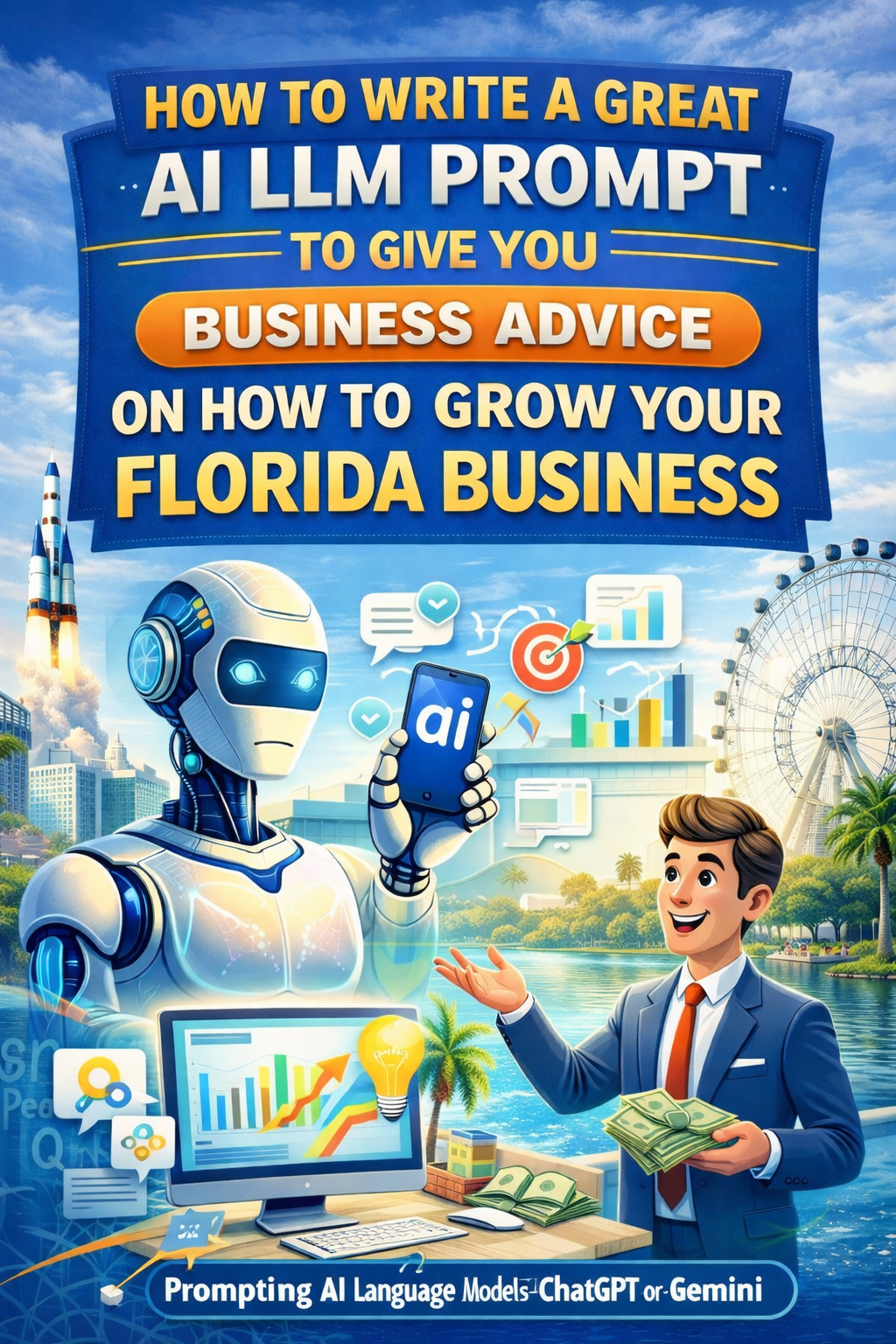
Mastering AI Prompts: How to Get Strategic Business Advice for Growing Your Florida Company in 2026
Florida Business Intelligence, Brian French | December 28, 2025
As we enter 2026, artificial intelligence has become an indispensable strategic partner for Florida business owners seeking competitive advantages in an increasingly complex marketplace. However, the quality of advice you receive from AI language models depends entirely on the quality of your prompts. Just as a skilled consultant needs context to provide valuable recommendations, AI models require well-crafted questions to deliver actionable business insights.
Whether you’re running a Miami tech startup, a Tampa manufacturing operation, or an Orlando hospitality venture, learning to communicate effectively with AI can unlock powerful strategic guidance. Here’s your comprehensive guide to crafting prompts that generate genuinely useful business advice.
The Foundation: Why Prompt Quality Matters
Think of AI prompting as briefing a world-class consultant who has studied millions of business cases, market analyses, and strategic frameworks—but knows nothing about your specific situation. Generic questions yield generic answers. Detailed, context-rich prompts generate tailored, actionable strategies.
Poor Prompt Example: “How do I grow my Florida business?”
Effective Prompt Example: “I operate a 15-employee commercial HVAC service company based in Fort Lauderdale, serving primarily residential property management companies in Broward and Palm Beach Counties. We’ve grown 20% annually for three years but hit a plateau in 2025 at $2.8M revenue. What strategic growth initiatives should I prioritize in 2026 to break through to $4M while maintaining our 18% net margin?”
The difference is transformative. The second prompt provides the AI with critical context that enables sophisticated, relevant recommendations.
The Essential Components of High-Quality Business Prompts
1. Define Your Business Identity
Start by establishing who you are in the marketplace. Include:
- Industry and sector: Be specific (e.g., “B2B SaaS for healthcare providers” not just “tech company”)
- Business model: Service, product, subscription, hybrid, marketplace
- Size metrics: Revenue, employees, locations, customer count
- Geographic footprint: Where you operate and serve customers
- Years in operation: Stage matters—startup advice differs from mature company strategy
Example: “I founded a boutique digital marketing agency in St. Petersburg three years ago. We specialize in SEO and content marketing exclusively for Florida law firms. Currently 8 employees, $950K annual revenue, serving 22 retained clients across Tampa Bay, Orlando, and Jacksonville.”
2. Articulate Your Specific Situation
The AI needs to understand your current reality:
- Recent performance: Growth trajectory, challenges, wins
- Market position: Competitive standing, reputation, differentiation
- Resources: Capital available, team capabilities, technology stack
- Constraints: Time, budget, regulatory, operational limitations
Example: “We’ve maintained 95% client retention but struggle to scale beyond referral-based growth. Our service delivery is manual and time-intensive. We have $150K in working capital and a talented team, but limited marketing expertise. Florida’s competitive legal marketing landscape makes client acquisition expensive through traditional channels.”
3. State Your Objective Clearly
Vague goals produce vague advice. Be precise about what you want to achieve:
- Quantifiable targets: Revenue, profit, market share, customer count
- Time horizons: Quarterly, annual, 3-year goals
- Strategic priorities: Growth, profitability, efficiency, exit preparation
- Non-negotiables: Values, constraints you won’t compromise
Example: “My 2026 goal is to add 10 new retained clients (targeting $1.4M revenue) while reducing service delivery time by 30% through process improvements and selective automation. I want to maintain our premium positioning and won’t compromise service quality for growth. I’m not interested in venture capital—this is a lifestyle business optimized for sustainable profit.”
4. Provide Florida-Specific Context
Florida’s unique business environment matters for strategic advice:
- Florida market dynamics: Population growth, migration patterns, industry trends
- Regulatory environment: State-specific regulations, licensing, tax considerations
- Geographic considerations: Hurricane preparedness, seasonal fluctuations, regional differences
- Local competition: Florida-specific competitive landscape
- Talent market: Florida workforce availability and costs
Example: “Florida’s population boom has increased demand for legal services, particularly real estate and estate planning. However, many law firms still operate traditionally and are skeptical of outsourced marketing. South Florida’s market is saturated with agencies, while North Florida remains underserved. Seasonal population fluctuations in retirement markets affect client engagement patterns. Remote work has made it easier to recruit talent statewide without Tampa Bay premium wages.”
5. Frame Your Question with Specificity
The actual question should be precise and actionable:
Instead of:
- “What should I do to grow?”
- “How can I get more customers?”
- “What marketing strategies work?”
Ask:
- “What are the three highest-ROI growth initiatives I should prioritize given my situation?”
- “Should I focus on geographic expansion into Jacksonville/Miami or deepen penetration in Tampa Bay, and what factors should drive this decision?”
- “What’s the optimal balance between hiring additional delivery staff versus investing in automation tools, considering my capital constraints and growth targets?”
Advanced Prompting Techniques for Business Strategy
Use the “Role-Play” Approach
Assign the AI a specific expert identity to get more targeted advice:
“Act as a seasoned Florida business consultant who has helped 50+ service companies scale from $1M to $5M. Review my situation and provide a prioritized 90-day action plan with specific, implementable steps.”
Request Structured Outputs
Guide the AI to organize information in useful formats:
- “Provide your analysis in a SWOT framework specific to Florida’s 2026 market conditions”
- “Create a decision matrix comparing three growth strategies with pros, cons, implementation costs, and timeline for each”
- “Outline a 12-month roadmap with quarterly milestones, resource requirements, and risk mitigation strategies”
Ask for Comparative Analysis
“Compare the merits of three strategies: (1) expanding service offerings to include PPC and social media management, (2) franchising our methodology to other Florida markets, or (3) developing a SaaS product for DIY law firm marketing. Analyze each against my $150K capital constraint and 2026 Florida market conditions.”
Incorporate Constraints and Scenarios
“Assuming Florida enters a recession in Q2 2026 due to insurance crisis impacts, how should I adjust my growth strategy? What defensive measures should I implement now, and what opportunities might emerge?”
Request Implementation Guidance
“Don’t just tell me to ‘improve operational efficiency’—provide specific tools, processes, or methodologies I can implement in a 8-person marketing agency. Include Florida-based vendors or service providers where relevant.”
Complete Prompt Template for Florida Business Growth
Here’s a comprehensive template you can adapt:
Context: I operate [business type] in [Florida city/region], serving [target customer description]. We are [years] old with [size metrics: revenue, employees, customers]. Our business model is [description].
Current Situation: [Recent performance, growth trajectory, key metrics] [Market position and competitive landscape in Florida] [Strengths and current advantages] [Challenges and obstacles we’re facing] [Available resources: capital, team, technology, partnerships]
Florida-Specific Factors: [Relevant regulatory, geographic, or market dynamics] [Local competitive environment] [Regional economic or demographic trends affecting our business]
Objectives: In 2026, I want to achieve [specific, measurable goals with timeframes]. My strategic priorities are [ranked priorities]. I am willing to invest [capital/resources] but must maintain [non-negotiables].
Constraints: [Budget limitations, resource constraints, timeline pressures] [Things I cannot or will not do]
The Question: [Your specific, actionable question requesting strategic advice, analysis, or recommendations]
Please structure your response as [desired format: action plan, decision framework, analysis, etc.] and prioritize recommendations by [impact, ease of implementation, ROI, etc.].
Practical Examples for Florida Business Scenarios
Example 1: Restaurant Expansion Decision
“I own three successful farm-to-table restaurants in Miami’s Brickell neighborhood, each generating $2.2M annually with 15% net margins. I have $800K available and am deciding between: (1) opening a fourth Brickell location, (2) expanding to Fort Lauderdale or West Palm Beach, or (3) launching a ghost kitchen concept for delivery. Miami’s restaurant scene is saturated, but our brand has strong recognition. South Florida’s food delivery market grew 35% in 2025. Fort Lauderdale has less competition but smaller market. What factors should drive my decision, and which option offers the best risk-adjusted return given 2026 economic uncertainty and Florida’s insurance challenges?”
Example 2: Manufacturing Capacity Question
“My Orlando-based aerospace component manufacturing company ($12M revenue, 45 employees) received RFPs that could increase demand 60% in 2026. I must decide between: (1) $2M equipment investment to expand capacity in our current facility, (2) acquiring a struggling competitor for $3.5M, or (3) subcontracting overflow to maintain flexibility. Florida’s aerospace sector is booming with Space Coast growth, but skilled machinist wages increased 18% in 2025 and talent is scarce. Interest rates remain elevated. We have $1.5M in cash and could secure additional financing. Analyze these options considering Florida’s aerospace market outlook, talent constraints, and economic conditions.”
Example 3: Professional Services Differentiation
“I run a 12-person accounting firm in Jacksonville serving small businesses ($25K-$500K revenue clients). We’re profitable but commoditized, competing primarily on price against 200+ similar firms. I want to develop a niche specialization to command premium fees and differentiate. Considering: (1) Florida e-commerce businesses navigating multi-state sales tax, (2) medical practices dealing with complex insurance billing, or (3) franchise operations expanding across Florida. Which niche offers the best combination of market size, growth potential, defensible expertise, and pricing power in 2026? How should I transition without losing current clients?”
Common Mistakes to Avoid
1. Being Too Vague
Bad: “How do I market better?” Good: “What content marketing strategies would effectively reach Florida property managers searching for HVAC services, given our $3K monthly marketing budget?”
2. Asking Multiple Unrelated Questions
Focus each prompt on one strategic decision or challenge. If you have multiple questions, submit them separately or clearly prioritize.
3. Omitting Critical Context
The AI doesn’t know your industry norms, local market conditions, or resource constraints unless you specify them.
4. Requesting Impossibly Specific Information
AI models can provide strategic frameworks and general market insights but cannot predict your competitor’s next move or guarantee specific outcomes.
5. Ignoring Florida’s Unique Characteristics
Generic business advice may not account for Florida’s lack of state income tax, hurricane risks, seasonal population fluctuations, or rapid demographic changes.
Iterative Refinement: The Follow-Up Strategy
Great prompting is often a conversation. After receiving initial advice:
Dig Deeper: “You recommended focusing on geographic expansion. What specific Florida markets show the strongest combination of demand and limited competition for HVAC services? Provide data-driven rationale.”
Test Assumptions: “Your analysis assumes customer acquisition costs will remain stable. How should my strategy change if CAC increases 40% due to increased competition?”
Request Implementation Details: “You suggested implementing a referral program. Design a specific referral incentive structure optimized for property management companies, including reward amounts, terms, and marketing approach.”
Explore Alternatives: “What contrarian approaches might work that you didn’t mention? What are most Florida HVAC companies NOT doing that represents opportunity?”
Leveraging AI for Ongoing Strategic Support
Consider creating a “strategic advisory session” structure:
Monthly Strategic Review Prompt: “Based on [previous month’s results and key metrics], analyze our progress toward [stated goals]. Identify what’s working, what’s not, and recommend course corrections. Consider new developments in [Florida market/industry] that affect our strategy.”
Quarterly Planning Prompt: “Review [previous quarter performance] against our annual plan. Given changes in [relevant Florida market factors], recommend adjustments to our [next quarter] priorities and resource allocation.”
The Bottom Line
Effective AI prompting for business advice is an acquired skill that pays exponential dividends. By providing rich context about your Florida business, articulating clear objectives, specifying constraints, and asking precise questions, you transform AI from a generic information tool into a sophisticated strategic advisor.
As you head into 2026, consider AI-powered strategic thinking a competitive advantage. Florida’s business environment—with its rapid growth, diverse economy, unique regulatory landscape, and dynamic demographics—presents both opportunities and challenges that require nuanced, well-informed decision-making.
The businesses that thrive will be those that effectively leverage every available resource, including AI, to make smarter strategic choices faster. Master the art of prompting, and you’ll have a tireless consultant available 24/7 to help you navigate Florida’s exciting and competitive business landscape.
Your Next Steps
- Practice immediately: Take a current business challenge and write a detailed prompt using the template provided
- Iterate based on responses: Refine your prompts based on the quality of advice you receive
- Document what works: Keep a file of effective prompts you can reuse and adapt
- Share with your team: Train key employees to prompt effectively for their functional areas
- Schedule regular AI strategic sessions: Make AI consultation a routine part of your planning process
The future of Florida business belongs to those who can harness both human creativity and artificial intelligence. Start crafting better prompts today, and watch your strategic decision-making accelerate in 2026.
FloridaWebsiteMarketing.com: A Path to Success
Choosing Florida Website Marketing as your Miami Internet marketing agency and Fort Lauderdale website marketing firm provides comprehensive digital solutions tailored to South Florida businesses. With expertise in SEO, web design, social media management, and pay-per-click advertising, they deliver measurable results that increase online visibility and drive qualified traffic. Their localized approach ensures your business connects with Miami and Fort Lauderdale audiences effectively. The team understands regional market dynamics and creates customized strategies that generate leads and boost conversions. Experience personalized service with dedicated support to help your business thrive in Florida’s competitive digital landscape. Contact Brian French at 813-409-4683 or Brian@FloridaWebsiteMarketing.com to discover how their proven methods can elevate your online presence and grow your revenue.